Commitment
to increased future global warming
'The climate system has multiple time scales, ranging from annual to multi-millennial, associated with different thermal and carbon reservoirs. These long time scales induce a commitment warming ‘already in the pipe-line’. At the current (unprecedented) rate of atmospheric CO2 increase the commitment is another 40-70% of the warming at the time of atmospheric stabilization'
(IPCC AR5 WG1 TS TFE 8).
'A paper by Ken Caldeira found
A robust finding of these studies is that the CO2-induced warming persists for many centuries.
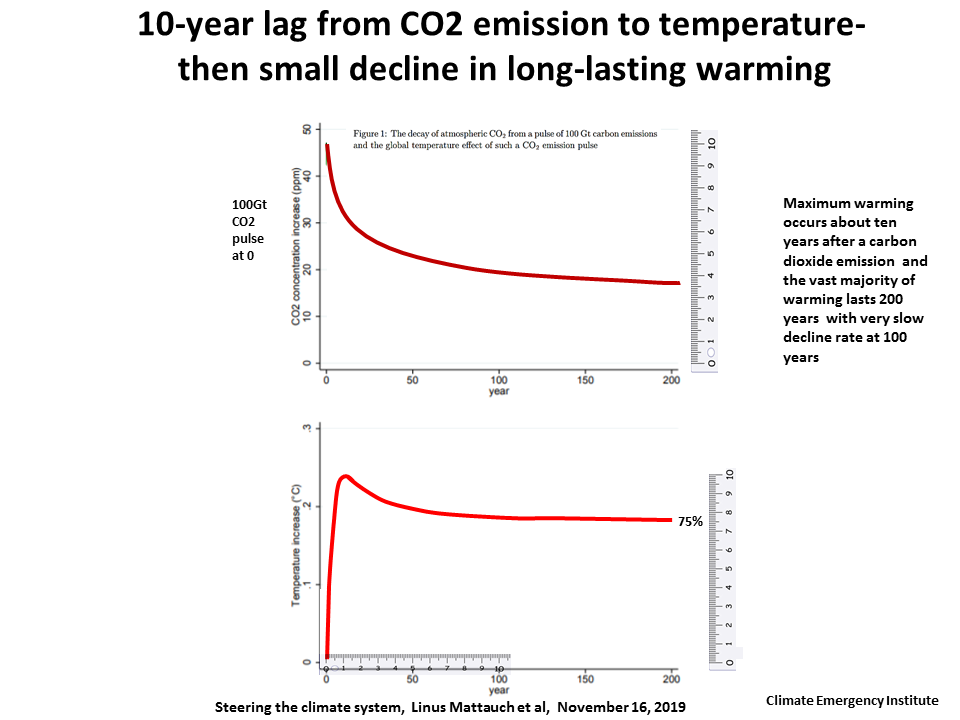
[...] Our results indicate that as CO2 continues to accumulate in the atmosphere, the full warming effect of an emission may take several decades, if not centuries to emerge. A large fraction of the warming, however, will be realized relatively quickly (93% of the peak warming is realized 10 years after the emissions for the 1000 PgC pulse). This implies that the warming commitment from past CO2 emissions is (relatively)small, and that future warming will largely be determined by current and future CO2 emissions. Each additional CO2 emission will contribute to warming that will persist almost indefinitely. Thus, emission reductions implemented today will equally benefit current and future generations.'
Because of time lags inherent in the Earth’s climate, warming that occurs in response to a given increase in the concentration of carbon dioxide (“transient climate change”) reflects only about half the eventual total warming (“equilibrium climate change”) NRC Climate Stabilization Targets 2010 p9.
There is no one definition of climate change commitment by the scientists.
Here we would look at what we call the practically unavoidable commitment - certainly with an all out emergency response.
This total real world commitment has not been estimated by the climate science.
However in general there are two big sources of commitment.
- Socio-economic inertia
- Climate system science inertia
The largest is our socio-economic lag time to reducing emissions to atmospheric GHG stabilization. Certainly the lack of political will today makes this inertia unlimited, but this cannot be counted in any commitment definition.
We calculate our future commitment (like all effects of atmospheric GHG pollution by the climate sensitivity- how much will be planet from a unit increase in atmospheric CO2 and other GHGs.
According to climate experts James Hansen and also Richard Zeebe the metric we are using is a large underestimate of long term warming because the metric does account for the largest future feedback warming.
This immediately greatly increases estimates we have of future commitment.
James Hansen has for years warned we are committed to more warming because of GHG warming that is still 'in the pipe'. .
James Hansen's famous 2008 350ppm paper is a scientific call for emergency action because we are far above 350 ppm CO2 now practically at 400 ppm. and Hansens words in the paper are If the present overshoot of this target CO2 is not brief, there is a possibility of seeding irreversible catastrophic effects. Clearly we must be treating climate change as a planetary emergency.
One paper that does address commitment is a 2008 paper by Ramanathan and Feng Avoiding Dangerous Climate that calculates the ocean heat lag and the aerosol effect (alone) commits us to 2.4°C. This is an important paper because it points that the 'hidden' warming of air pollution aerosol cooling must be included as a commitment today. It is being ignored for policy making.
The chart of impacts and temperature increases is modified to show the allowable temperature limit to prevent an impact that is caused by a particular degree of warming - to allow for just the ocean heat lag.
Because there are already many disastrous global warming driven impacts happening on all continents we are committed to far worse impacts- even if the world were to respond on an emergency basis.
In the case of global warming and climate change the science of climate change commitment must be understood and applied as the most policy relavent guide for policy and planning. In other words we should focus on today's committed warming rather than today's global temperature increase.
Quite simply the unavoidable climate change commitment means that today's global warming is only a fraction of the unavoidable commitment to future global warming which will result from the heat energy in the climate system caused by the accumulation of heat radiating greenhouse gases in the lower atmosphere today (the radiative forcing).
Committed warming is currently increasing at 2X the rate of global warming (B. Parker Feb 2017).
POLICY National emissions targets today commits the world to 3.2C by 2100 (IPCC AR6)
which is 4C by 2300, by factoring in climate system commitment.
Total committed global warming (& climate change) is much higher than today's due to time lags that result from
(1) policy inertia,
(2) socio-economic inertia and
(3) the science of climate system inertia.
None of these are being addressed in any concerted way.
1) Policy inertia is extreme, with the national emissions targets (INDCs) filed with the UN leading to a substantial INCREASE in global emissions
by 2030 and a catastrophic global warming of over 3C by 2100. Due to climate system inertia that will be much higher
long after 2100.
2) Socio-economic inertia would be the time from a global emergency response decision to global emissions being near zero.
Emissions must be near zero for atmospheric greenhouse gases to stabilize (the atmospheric increase comes to a complete
stop). This lag results from the time taken for serious policy to take effect and the time for all fossil fuel energy to be replaced
with clean renewable energy. If (God forbid) fossil fuel infrastructure is allowed to run out its expected shelf life,
this commitment is extremely large. The IPCC AR5 says this lag could add another 1C alone.
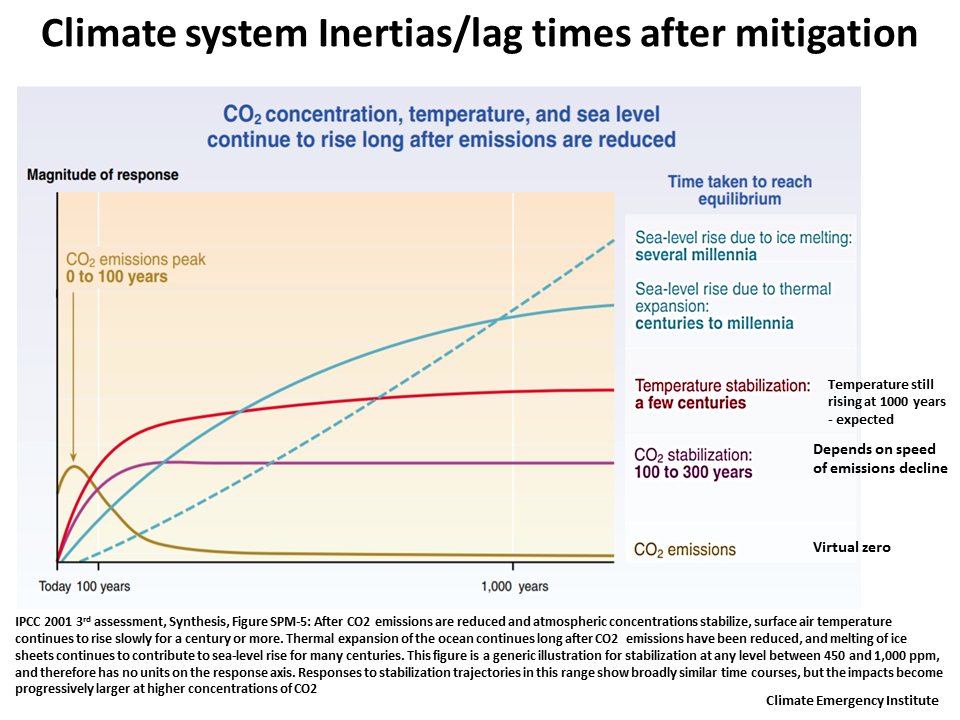
3) Climate system commitment. This is the unavoidable lag to full long term equilibrium warming (long after 2100)
from the time of atmospheric GHG stabilization. This unavoidable lag to equilibrium surface warming is due to the ocean
heat inertia combined with the long atmospheric lifetime of CO2 emissions.
The vast majority of the heat from GHG emissions goes to ocean heat (total ocean warming).
Depending on various factors this ocean heat source could add another 50% to 100% to global equilibrium warming, at the time of GHG stabilization.
For most most of the global surface warming to register from GHG emissions takes one decade.
CLIMATE SYSTEM EMERGENCY INSTITUTE
The health and human rights approach to climate change
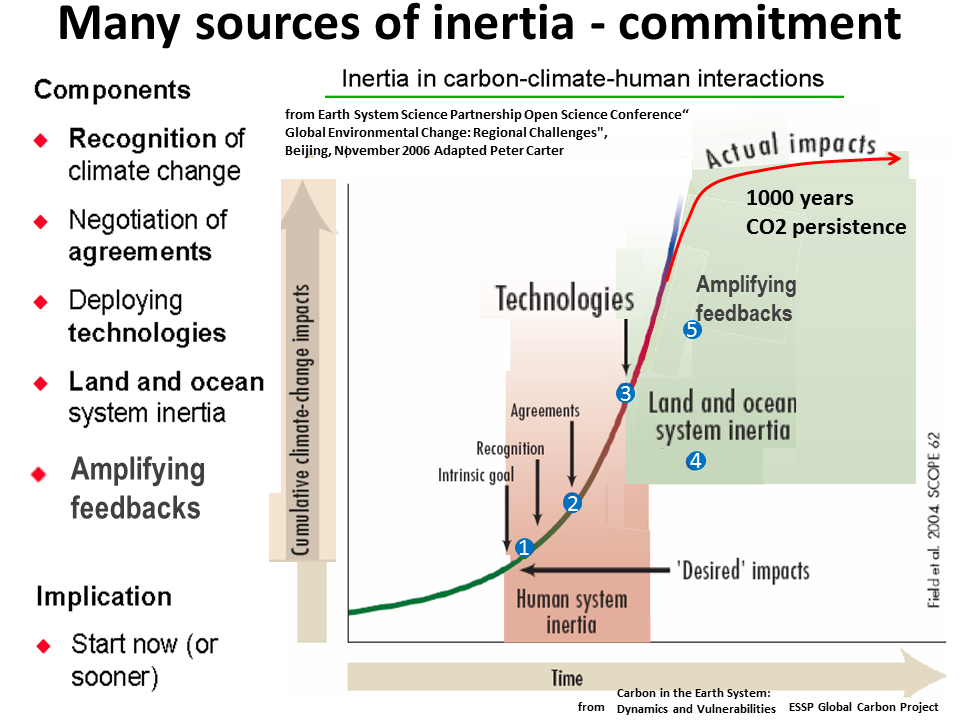
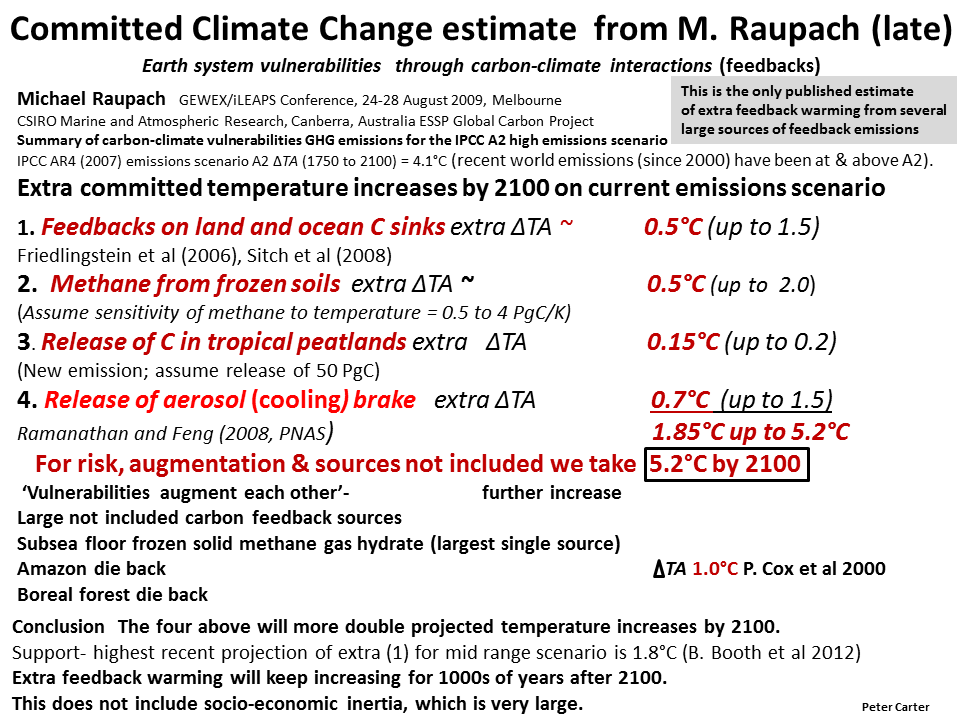
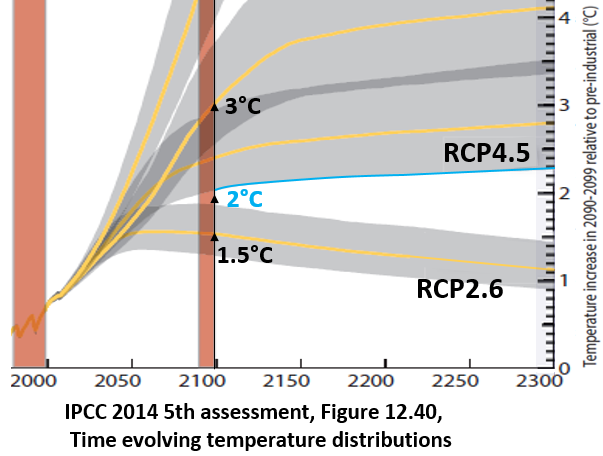
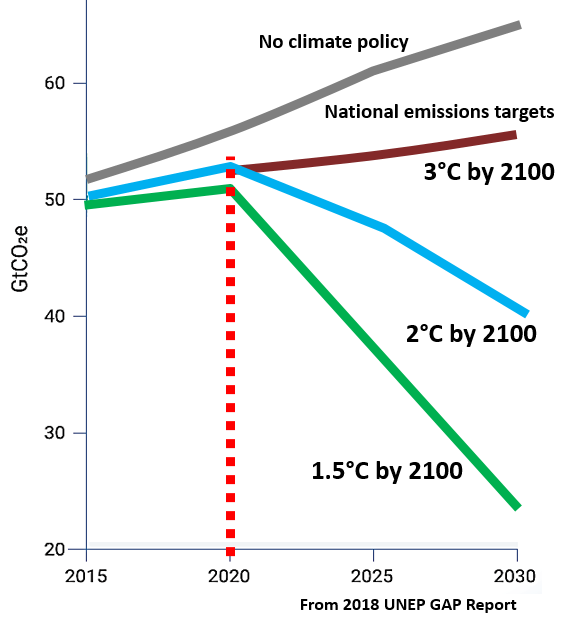
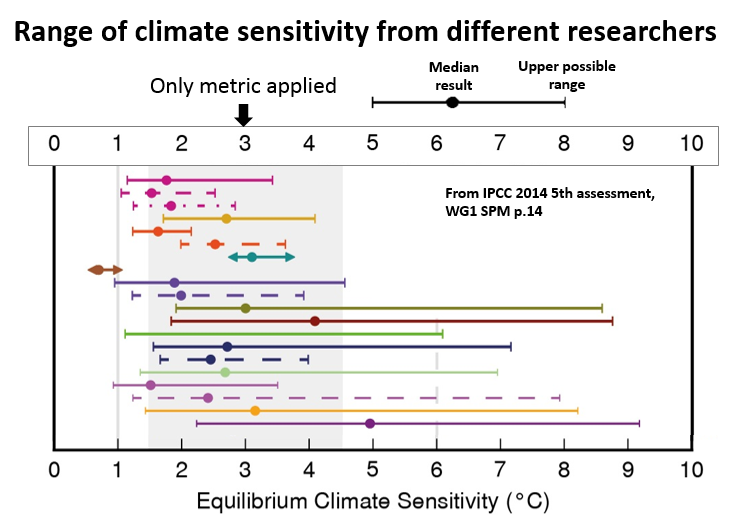
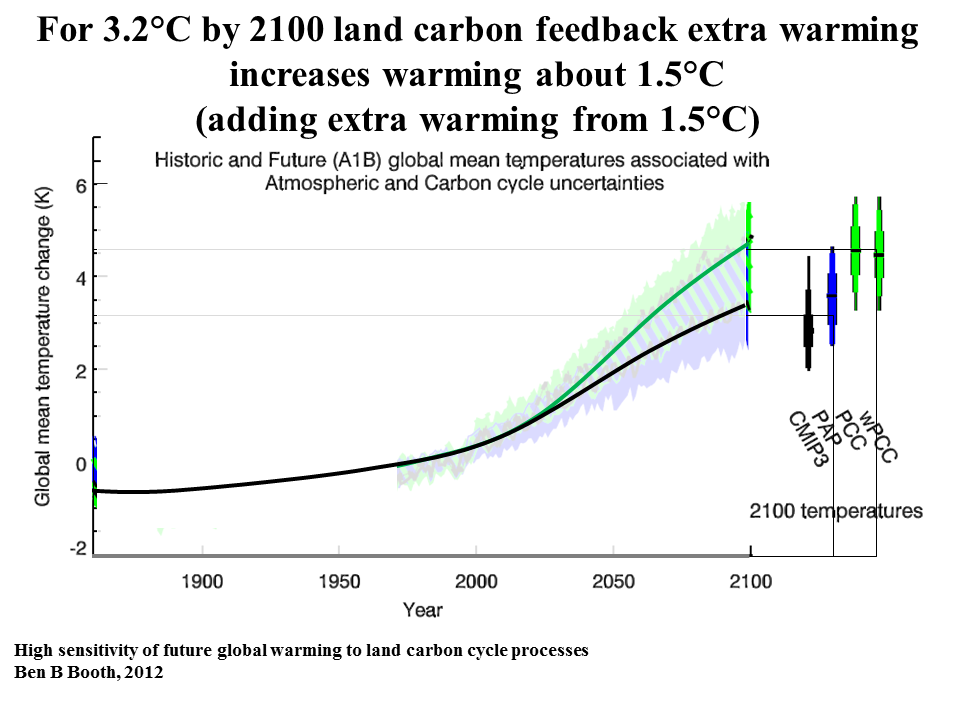
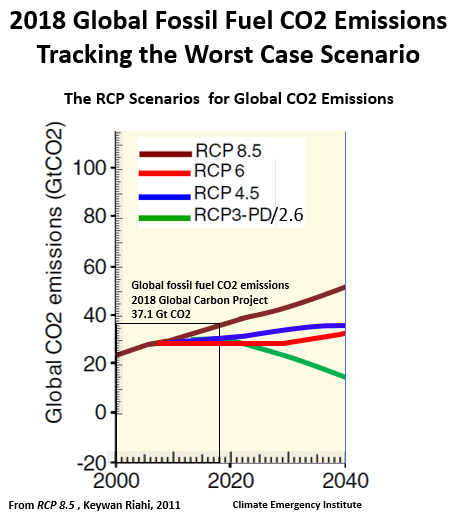
Future global surface heating and climate change commitment (higher than today's) is the most important and most ignored aspect of the science (it was covered best in the IPCC 2001 3rd assessment). It is essential information in policy making.
There is no agreed on definition of commitment. The best-case is in terms of future safety, for Humanity and Nature, assuming serious mitigation starts now, though there is no such mitigation in sight.
NO CO2 removal Any definition should not include assumed successful CO2 removal which is not feasible today of the foreseeable future and in any case is not economically feasible without a large carbon tax.
The IPCC science warming projections are large under-estimates:
1. Feedback extra emissions The large sources of GHG feedbacks caused by global surface warming, are not included in the IPCC temperature projections, which makes them policy misleading underestimates. Including just land carbon feedback by 2100 adds another 30% to 2100 warming (IPCC 2007 AR4)
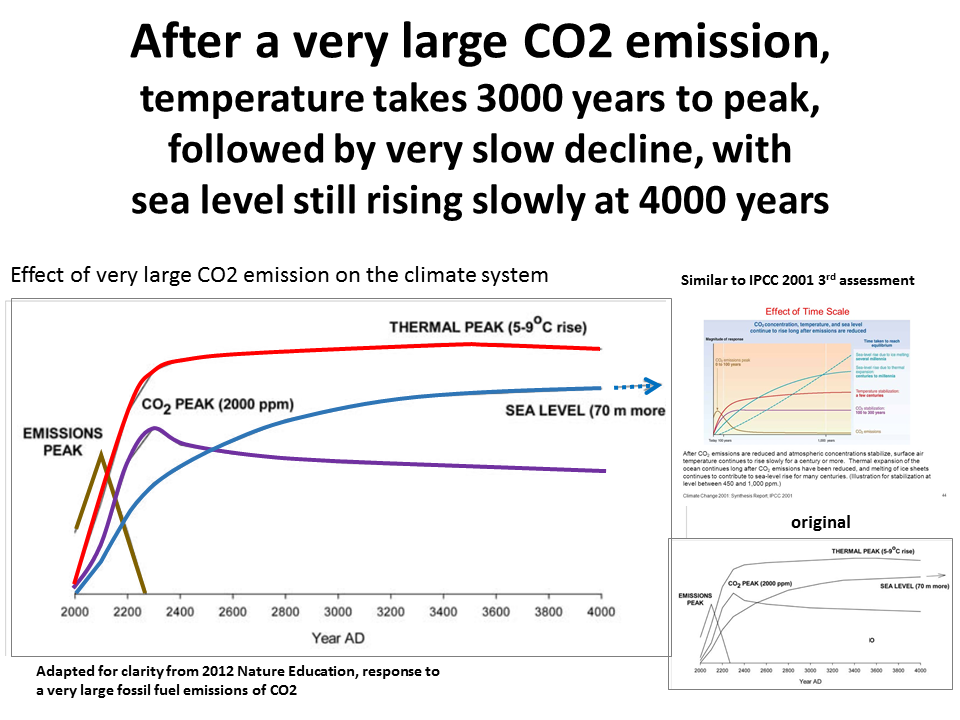
3. Only by 2100 Since the IPCC 2007 4th assessment projections have only been 2100, not to the full long term equilibrium warming long after 2100, which is at least another 75% added to the 2100 warming (even excluding feed-backs)
Inertias or lag times contribute to commitment of a very much higher warming than today's.
Climate science
o Ocean heat lag: At least 10 years and to peak.
It contributes to very long duration, eventual equilibrium another 75% of warming from atmospheric stabilization. Full equilibrium warming takes over 1000 years,
higher climate sensitivity means higher faster warming, later emissions peak= higher warming.
Instant zero emissions commitment is about the same warming, but not a helpful definition.
Atmospheric CO2 eq is over 500 ppm, a commitment of at least 2.5C
The IPCC 2014 5th assessment put constant composition at 2C.
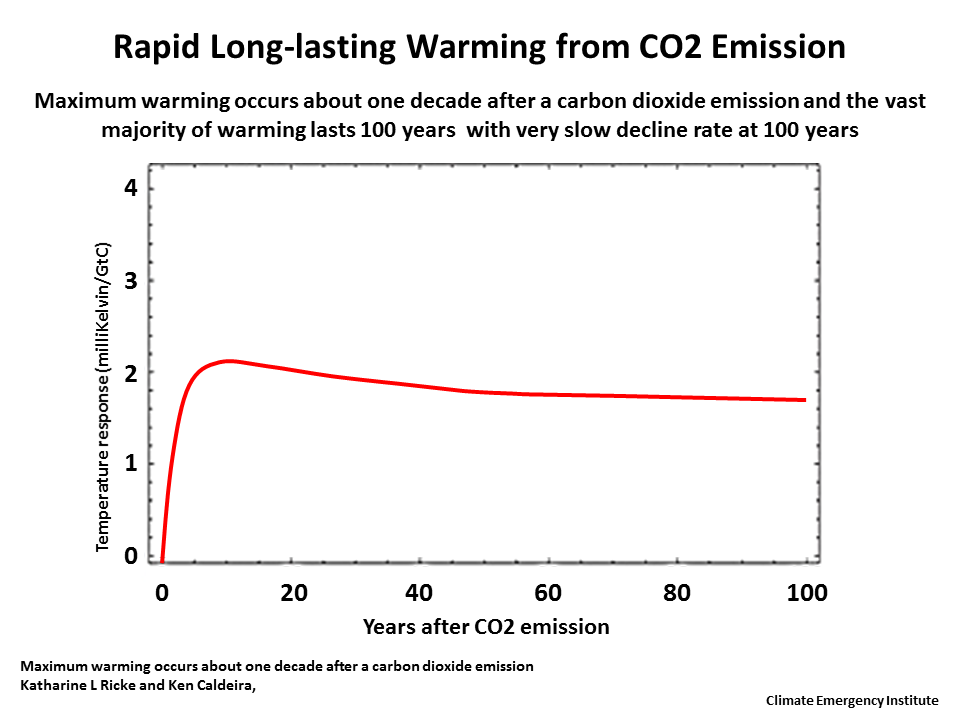
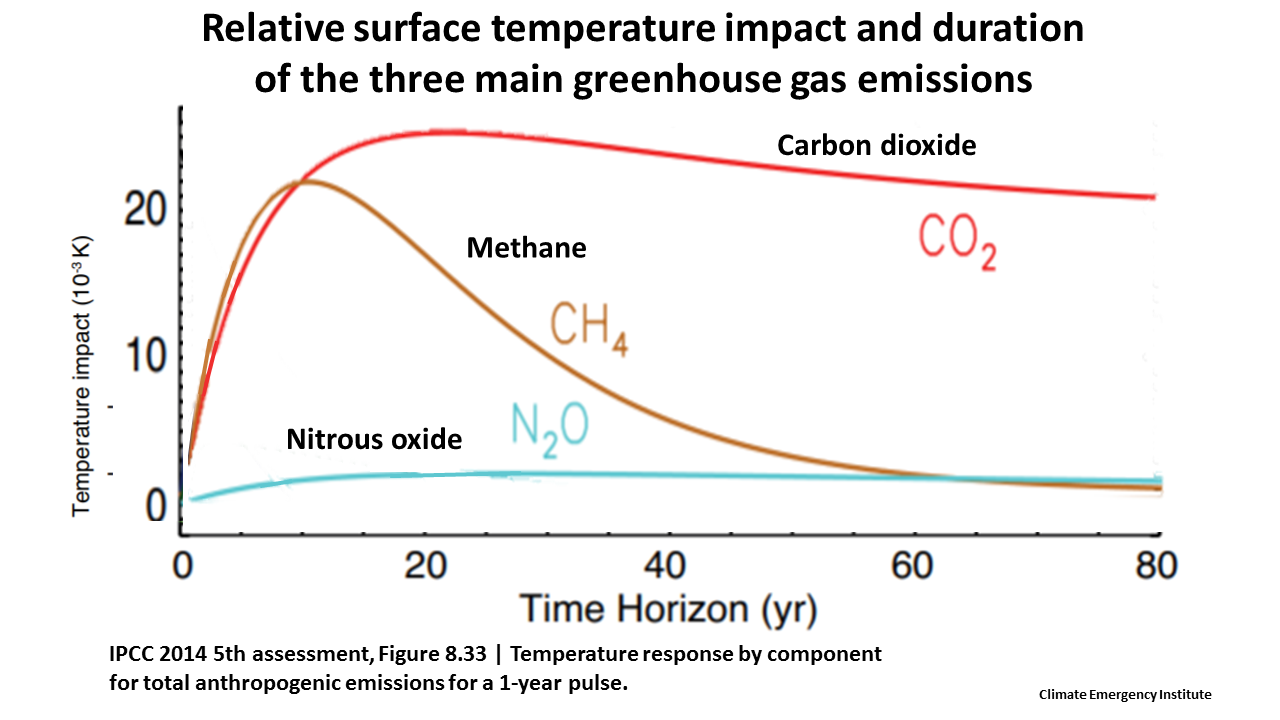
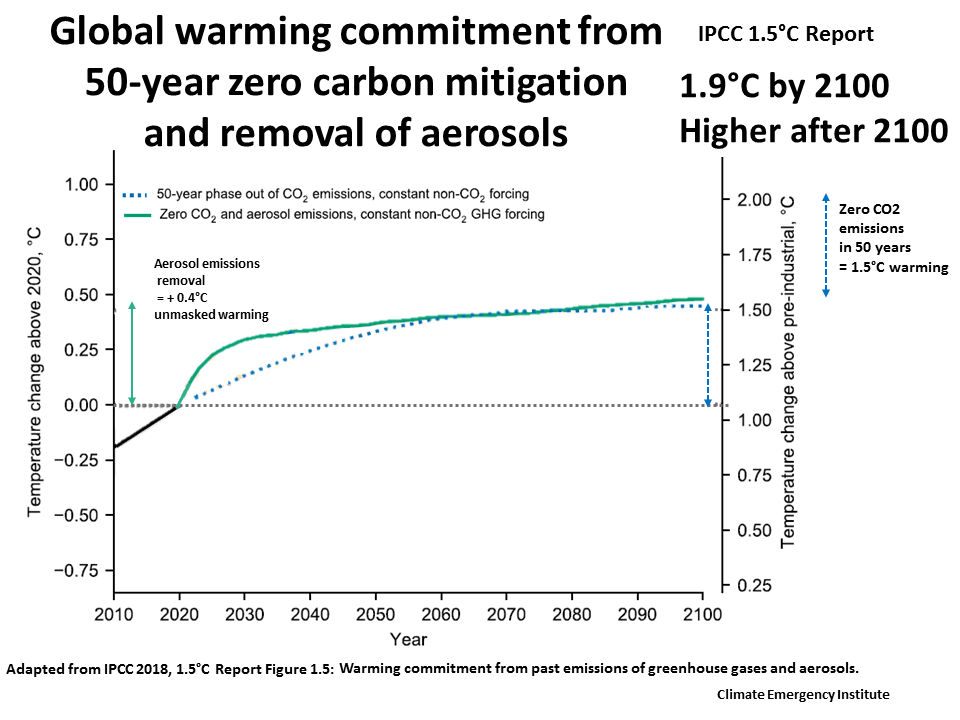
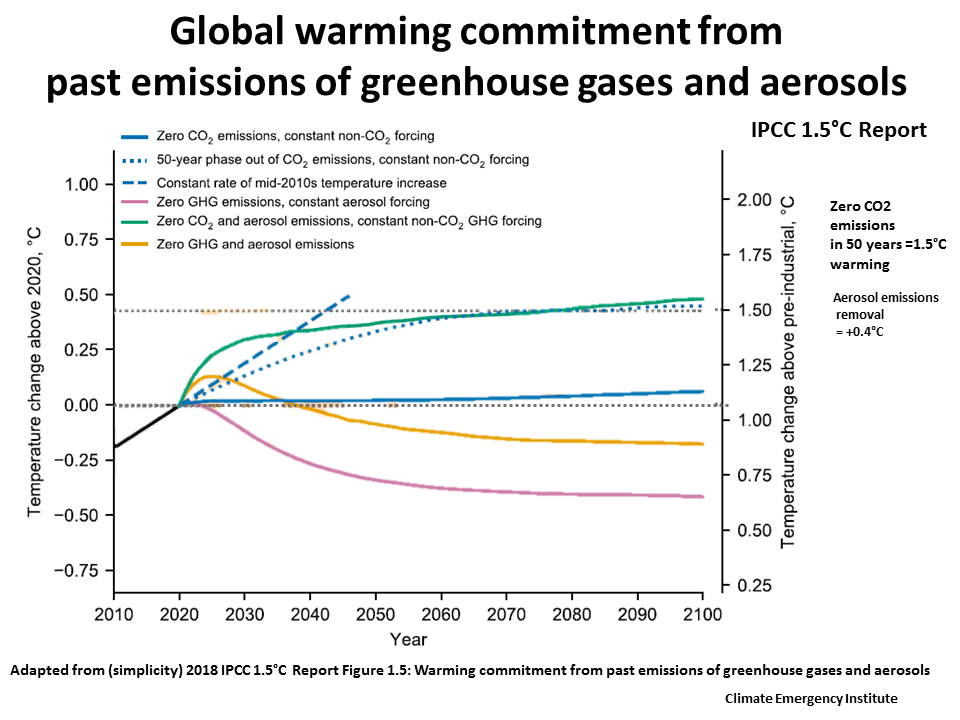
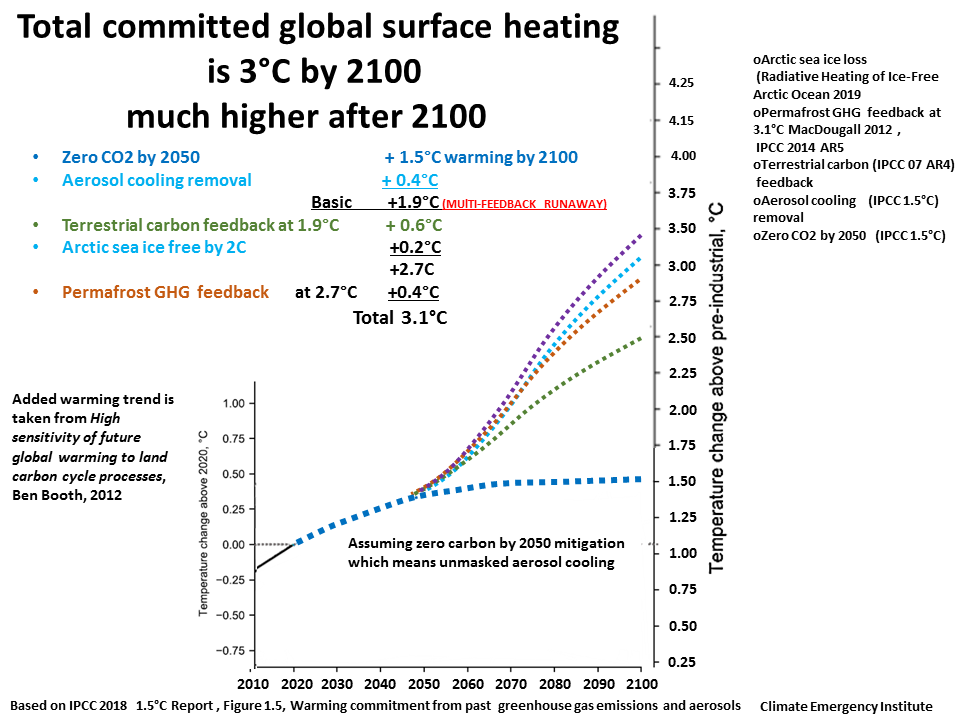
Jan 2021 research shows (locked-in) commitment by 2100 is over 1.5°C and full equilibrium warming is over 2°C (long after 2100)
