Tipping Points
Unchecked Climate change will put world at ‘tipping point’, WWF and Allianz 2009 report says
The report ‘Major Tipping Points in the Earth’s Climate System and Consequences for the Insurance Sector’ indicates that the world’s diverse regions and ecosystems are close to reaching temperature thresholds – or “tipping points” – that can unleash devastating environmental, social and economic changes, according to a new report by WWF and Allianz.
"The lack of determined action to reduce GHG emissions means that a warming almost certainly in excess of 2 °C and probably in excess of 3 °C sometime in the latter half of the 21st century is likely unless extremely radical and determined efforts towards deep cuts in emissions are put in place in the short term (by 2015). Alarmingly, this means that, conceivably, there could be tipping elements that have not been triggered yet but which we are
already committed to being triggered and/or have already been triggered, but we have yet to fully realize it because of a lag in the response of the relevant system." (above report by Tyndall Center)
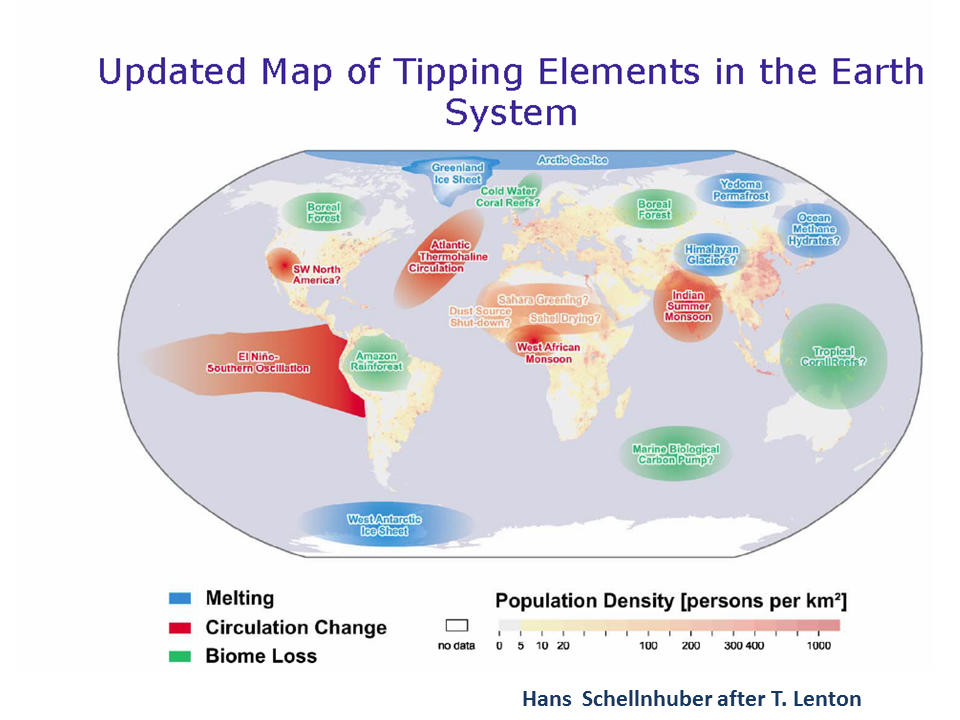
James Hansen has addressed the enormous danger of tipping points in one of his lectures (2009).
"Here are several climate tipping points of special concern. Tipping points are “non-linear” phenomena, which means that they can reach a point at which rapid catastrophic change occurs.
It is inherently difficult to determine the time at which non-linear collapse will occur, even in cases where such rapid change is certain.
Ice sheet disintegration The mechanism seems to be most important for disintegration of the great ice sheets that cover Antarctica and Greenland begins with ocean warming. Ocean warming leads to melting of ice shelves, which are tongues of ice that stretch out into the ocean. The ice shelves buttress the ice sheets, so when ice shelves disappear the more mobile parts of the ice sheet, the ice streams, can surge into the ocean – thus removal of the ice shelves is somewhat akin to taking the cork out of a bottle – it allows the material behind to flow rapidly. We know from Earth’s history that once ice sheet disintegration is well underway, sea level can rise by several meters per century.
Species extermination is also a non-linear problem. Today we are placing many species under multiple stresses, but one stress that is growing rapidly is the shifting of climate zones due to global warming. ... Because of interdependencies of species, the loss of key species can cause entire ecosystems to collapse.
Arctic methane. Methane is an especially powerful greenhouse gas. There are large amounts of methane presently locked up, frozen, in high latitude tundra and, especially, in ocean sediments on continental shelves. We know from Earth’s history that this frozen methane can be released suddenly by sufficient warming – thus this methane has the potential to greatly amplify human made
global warming, if that warming reaches a level, a tipping point, such that large volumes of frozen methane begin to melt."
The research on tipping points is directed not at compelling governments to curb emissions on an emergency basis, but to look for early warning indicators of tipping points. It is intuitive that there won't be early warnings and even if there jt would far to late to stop or slow the warming.
A 2010 study on tipping points: Early warning and wishful thinking finds that they have very limited predictability. The worst tipping point would be an abrupt large increase in global temperature. This paper takes the ice core abrupt warming events and finds no early warning indicators.
Like James Hansen, Andrew Gliskson finds from the ice core distant past that the planet tends to warm abruptly and we have added too much GHG heat to the system for any security of avoiding tipping points. Trends and tipping point in the climate system: portents for the 21st century. Past and current trends in the atmosphere/ocean system Andrew Glikson Earth and Palaeoclimate science Australian National University.
The Australia government office for science has background paper Dangerous Climate Change and Tipping Points includes a list of potential tipping points:
• rapid melting of the Greenland Ice Sheet
• collapse of the West Antarctic Ice Sheet
• abrupt retreat of Arctic summer sea-ice
• shut-down of the over-turning circulation in the Atlantic Ocean – also known as the ‘Atlantic Meridional Overturning Circulation’ (AMOC) or the Atlantic Thermohaline Circulation
• dieback of the Amazon rainforest
• rapid release of methane from permafrost or ‘methane hydrates’. Methane hydrates are structures consisting of methane locked into a water-ice lattice. They are sometimes referred to as ‘methane clathrates’. They occur in deep ocean sediments and under permafrost (frozen ground)
• sudden changes to marine ecosystems resulting from ocean acidification
What has been little attention is the possibility of self reinforcing +ve feedbacks or multiple cascading catastrophes reaching planetary tipping levels for a megacatastrophe. A Harvard discussion paper Responding to Threats of Climate Change Mega- Catastrophes does consider and how to respond to such a risk. This addresses the important question of rapid abatement and geo-engineering.
As there are many potential tipping and they inter-reinforcing risks for a planetary catastrophe this alone argues for the development of the rapid planetary emergency response capacity.
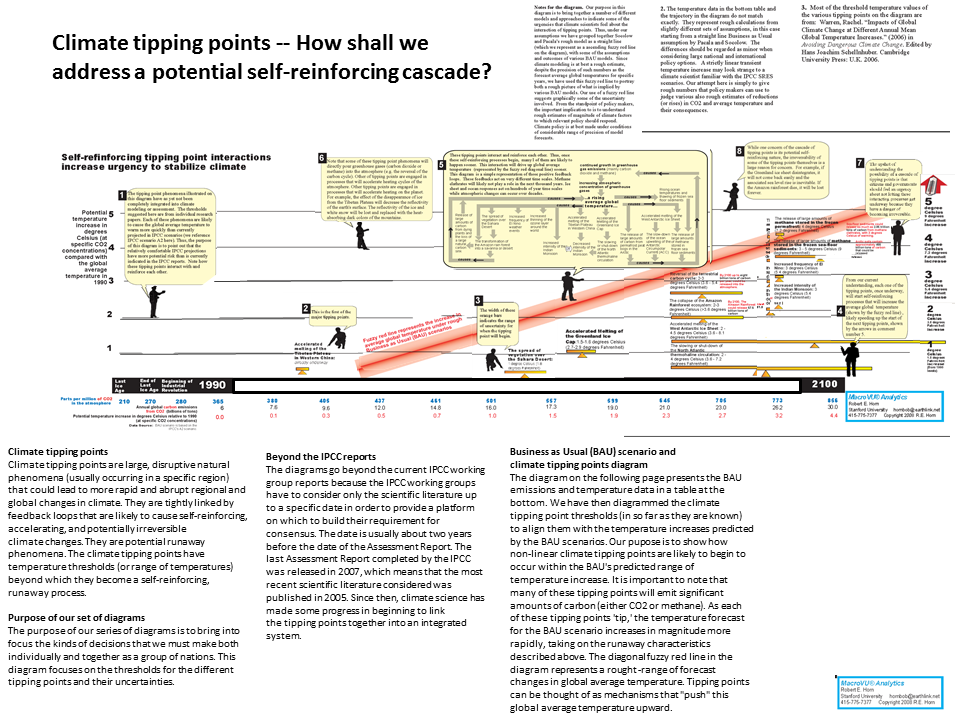
A global tipping point caused by industrial GHG global warming would be so-called 'runaway' global warming/ rapid global warming, abrupt global change, irreversible global climate change, in the science terms. This is a self accelerating multiple amplifying (mainly Arctic) feedback situation. Research published on 30 July 2013 suggests that this could happen.
CLIMATE EMERGENCY INSTITUTE
The Health and Human Rights Approach to Climate Change
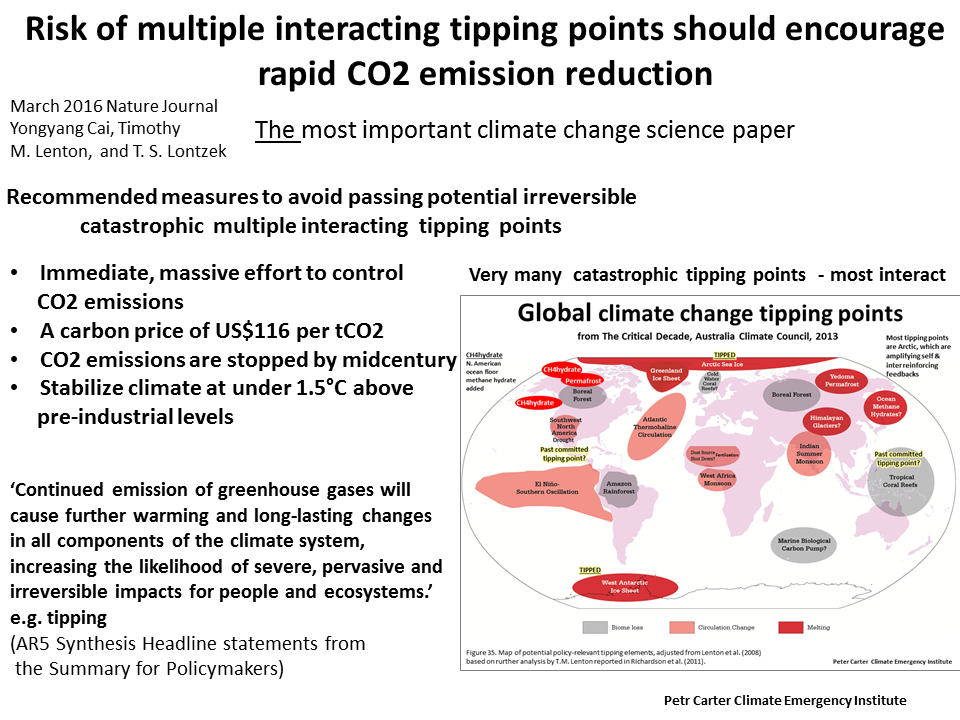
21 March 2016. Nature. Ground breaking most important paper Risk of multiple interacting tipping points
should encourage rapid CO2 emission reduction. Yongyang Cai, Tim M. Lenton, T. S. Lontzek
VIDEO 2013 Earth may reach tipping point Prof A. Barnosky
23 June 2017 Tipping points are real: Gradual changes in carbon dioxide levels can induce abrupt climate changes (abrupt extreme N.H. warming)
Good source NRC 2011 Earth's Deep Past Tipping points chapter
Climate tipping points —too risky to bet against, Nature, Nov 2019,
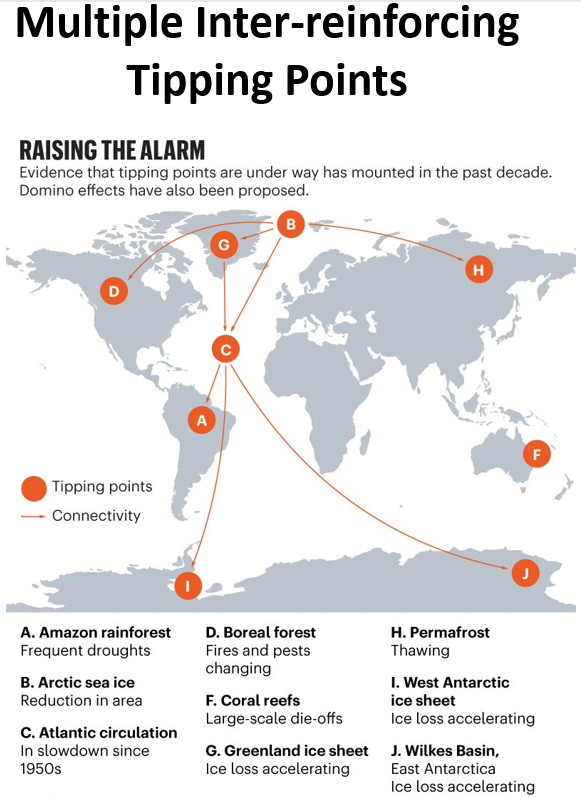
Feb 10th 2020 Carbon Brief Article 9‘tipping points’ that could be triggered by climate change
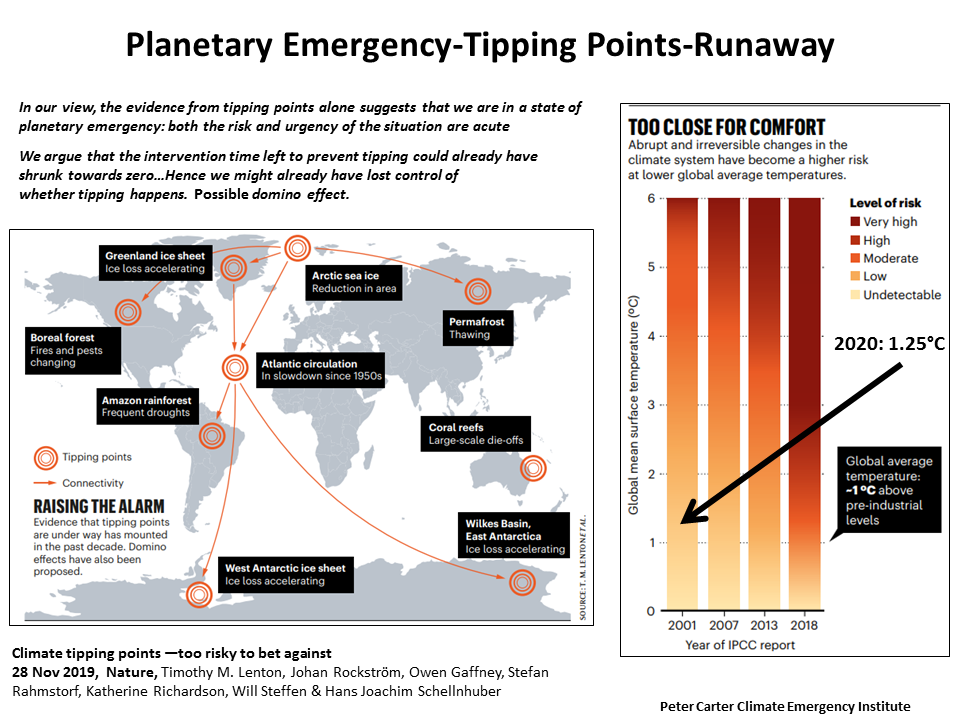

The IPCC Sixth Assessment Report (AR6) defines a tipping point as "a critical threshold beyond which a system reorganizes, often abruptly and/or irreversibly"
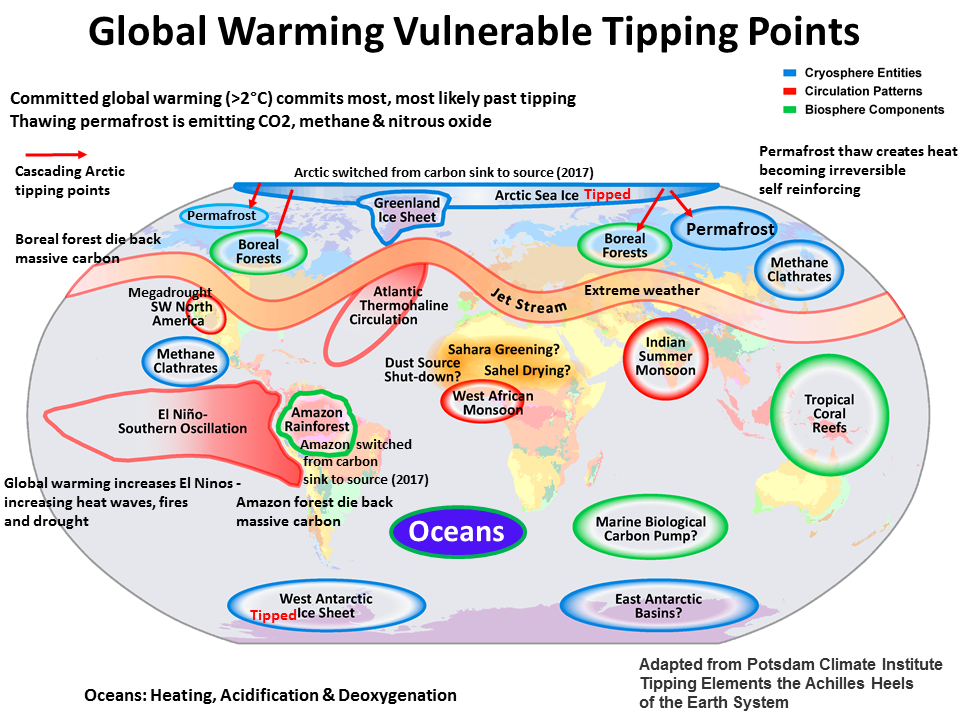
A climate tipping point is a critical threshold where a planetary or regional system experiences abrupt, often irreversible changes. Crossing these thresholds—such as large-scale ice collapses, widespread forest dieback, and disrupted ocean currents—can trigger compounding "tipping cascades" that drastically damage the bioshere.
Climate tipping points-How can we address a potential self-reinforcing cascade