GHG Pollution Promoting Subsidies
All fossil fuel subsidy studies, going back many yeras, find they are damaging socially and economically, as well as to the naturalenvironment
22 Oct 2015 IISD Known a long time Phasing Out Fossil Fuel Subsidies Would Result in
Large Reduction in Greenhouse Gas Emissions by 2020
This continues a most evil trend. As climate impacts increase worldwide and fossil fuels get harder to extract- government subsidies to the fossil fuel industries increase. It stinks of corruption.
The world perverse and irrational world economic system is extremely biased to continued fossil fuel dependence and economic dominance.
Another economic cheat is future discounting, which cannot be applied to climate change because the costs increase enormously with future time.
Major international organizations such as the World Bank, IEA, OECD and IMF for many years have issued reports calling for reform of fossil fuel subsidies, that are not justified on any environmental social or economic basis.
Environmental NGOs have called for the elimination of fossil fuel subsidies and had been taken up at UN Climate conferences (#ENDFOSSILFUELSUBSIDIES!.
Greenpeace has issued a report to the UNFCCC on the issue. Submission to the Ad Hoc Working Group on Enhanced Action ... for Further Increasing the Level of Ambition TASK 1: PHASE OUT FOSSIL FUEL SUBSIDIES.
The industries that are the main source of all three greenhouse gases are subsidized by governments.
International organizations have reported for decades on the unjustified and harmful fossil fuel subsidies that promote emissions.
Increasingly subsidies promote the expansion of the national gas industry, a large source of methane emissions, in addition to CO2.
The livestock industry, the main source of our methane emissions, is subsidized.
Published in 2013 TRUCOST NATURAL CAPITAL at Risk Top 100 Externalities at
Risk an important report on the amount of world externalities.
This found that externalized costs that promote atmospheric GHG pollution are extremely large.
• GHG emissions US$2.7 trillion;
• air pollution US$0.5 Trillion and
• land use (livestock production mainly) US$1.8 Trillion.
It is the ultimate no-brainer that all these fossil fuel subsidies must be stopped in short order and that the direct subsidies must be transferred to the clean zero carbon everlasting energy industries.
Amazingly, over the past 15 years many international organizations, including the World Bank, the IMF, OECD, and the international energy agency, have published reports on fossil fuel subsidies saying there is no justification for them economically and environmentally or socially and that they should be reformed.
The International Institute for Sustainable Development got the ball rolling on stop fossil fuel subsidies in its Global Subsidies Initiative.
Greenpeace has been researching, reporting, and opposing the fossil fuel subsidies for a great many years.
OIl Change International has a campaign directed at the true of fossil fuels and stopping the subsidies.
CLIMATE EMERGENCY INSTITUTE
The Health and Human Rights Approach to Climate Change
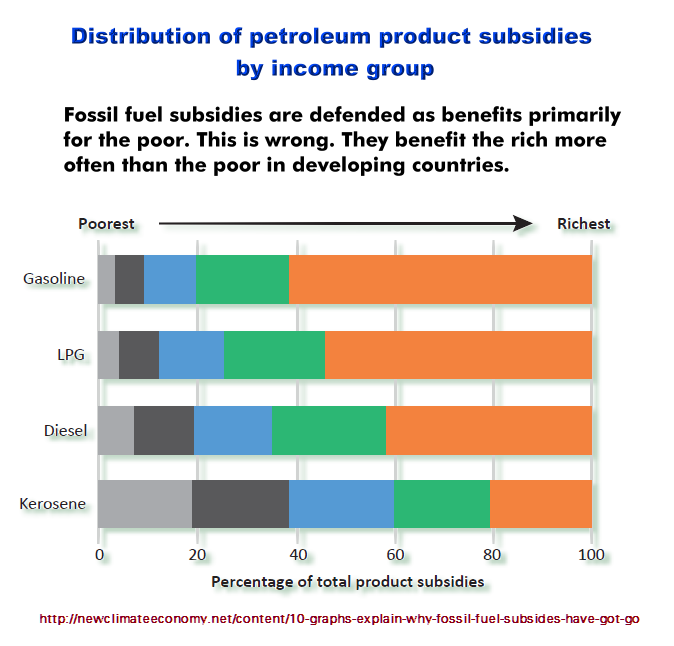
Fossil Fuel subsidies benefit the rich not the poor
Environmental economics
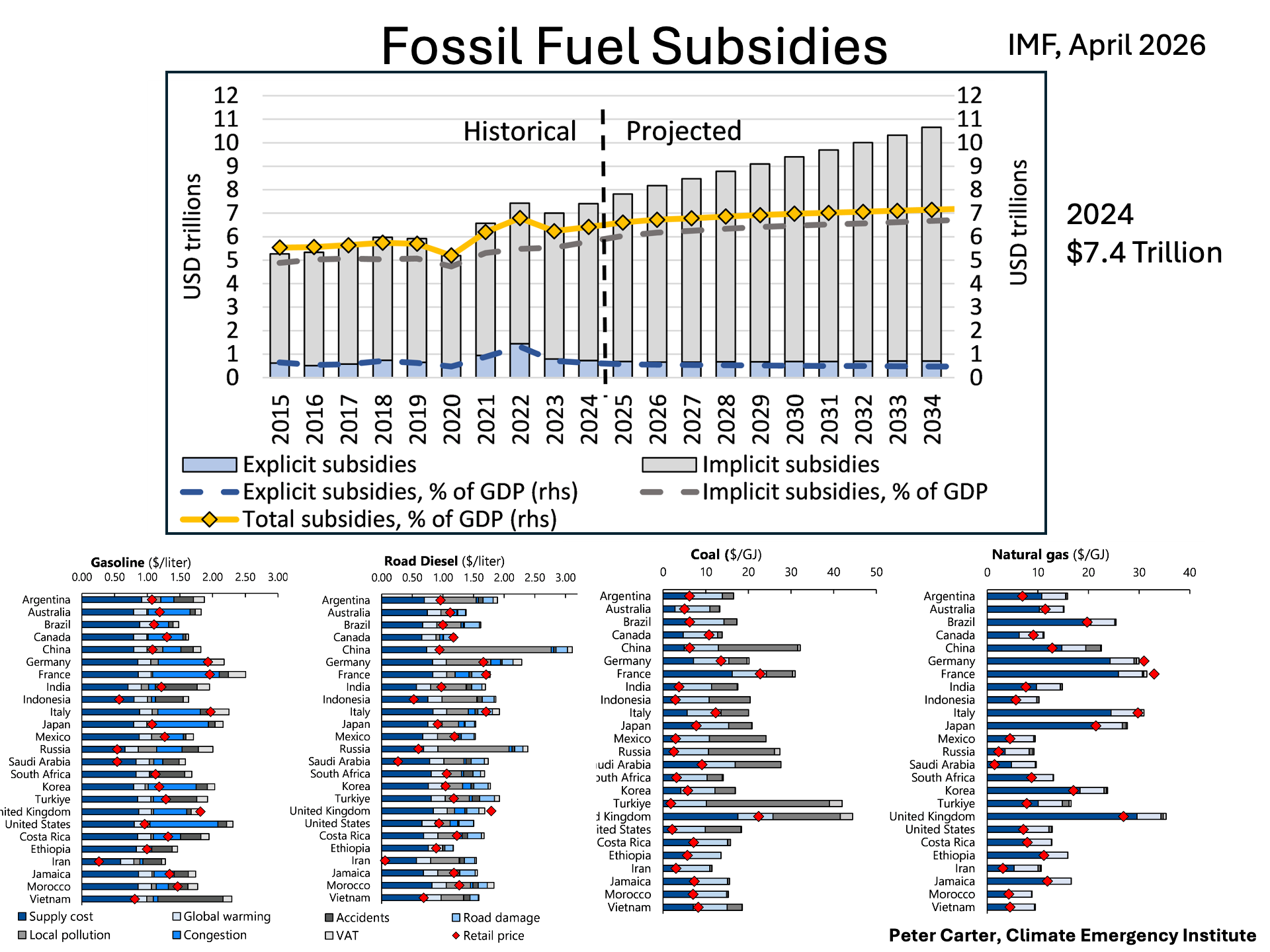
IGlobally, subsidies remained large projected at $7.4 trillion in 2024
The largest subsidizers were the Middle East and North Africa (MENA, Europe and Central Asian (ECA) regions account for the majority of explicit subsidies.
Fossil Fuel subsidies are increasing, and the IMF predicts this will continue-see graph.
The IMF report back in 2013 said that fossil fuel subsidies amount to
'a staggering $1.9 trillion world wide'.
Most of the IMF subsidy amounts are not accounted so avoided socio-environmental costs (called externalities). These should charged by government to the fossil fuel corporations as pollution fees.
The Crime of All time