Ocean Acidification
Feb 2016 Sea Change: the Pacific's perilous turn Excellent article explaining the issue
More on the science
Prior to industrialization, the concentration of carbon dioxide in the atmosphere was 280 parts per million (ppm).
With increased use of fossil fuels, that number is now over 428 ppm and the growth rate is accelerating.
Scientists calculate that the ocean is currently absorbing about one quarter of the CO2 that humans are emitting.
Acidification is measured red as pH (hydrogen ion concentration) with each unit on the pH scale representing a tenfold change in acidity.
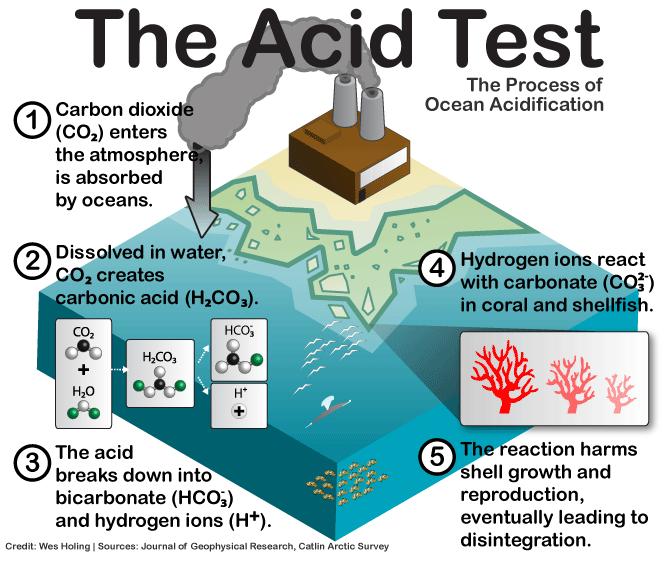
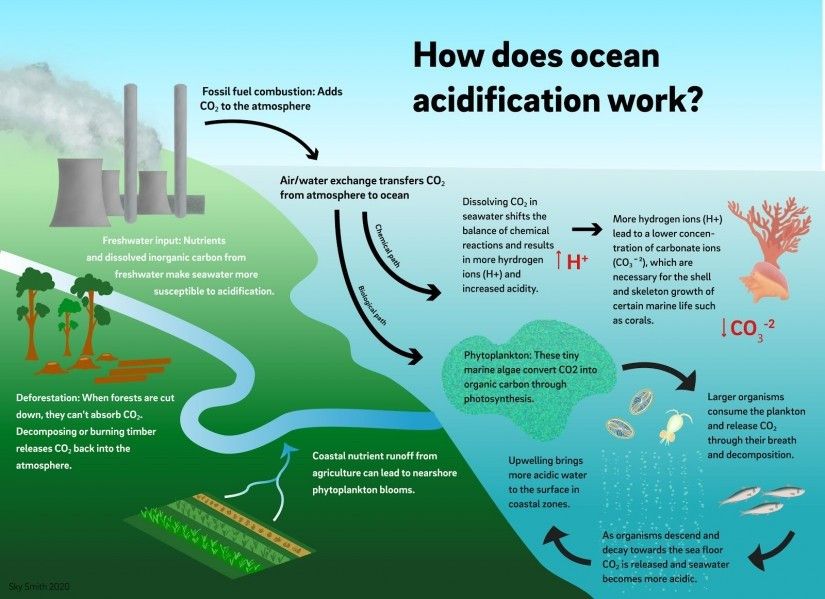
When CO2 combines with seawater, chemical reactions occur that reduce the seawater pH. pH is the measure of relative alkalinity and acidity.
Seawater has a pH of 8.2 on average because it contains naturally occurring alkaline ions that come primarily from weathering of continental rocks. When seawater absorbs carbon dioxide from the atmosphere, carbonic acid is produced surface ocean pH has decreased.
The average pH of ocean surface waters has fallen by about 0.1 units, from 8.2 to 8.1, since the beginning of the industrial revolution.
This corresponds to a 26% increase in acidity. This makes ocean acidification today the highest in over 20 million years.
Because the pH scale is logarithmic (a change of 1 pH unit represents a tenfold change in acidity), this change represents a 26 percent increase in acidity over roughly 250 years.
As the ocean absorbs excess atmospheric carbon dioxide the chemical balance of seawater changes, reducing its capacity to buffer further CO2 absorption and also directly harming the marine life responsible for the biological carbon pump
Japan Met best data site Ocean acidification in the western North Pacific

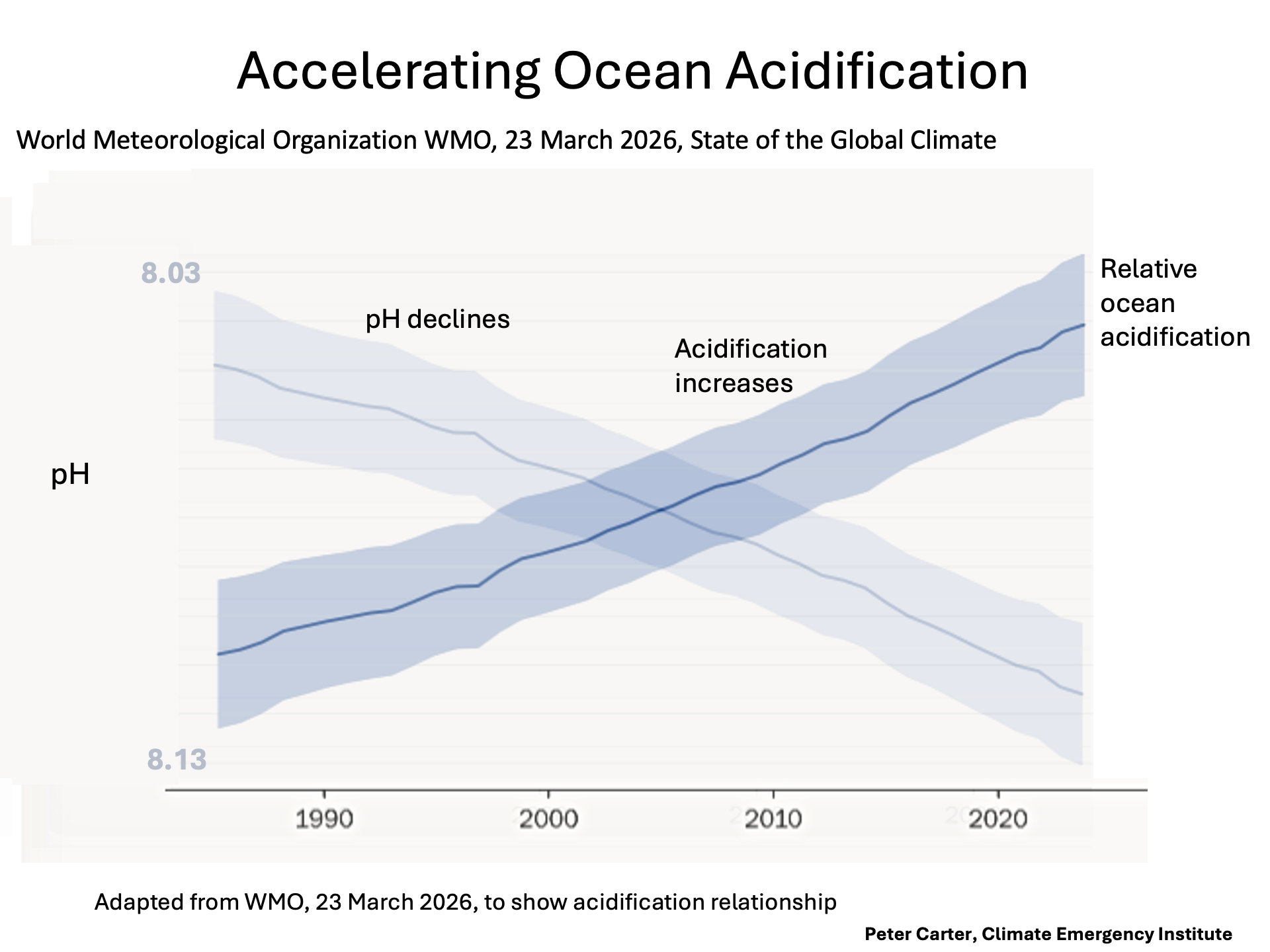
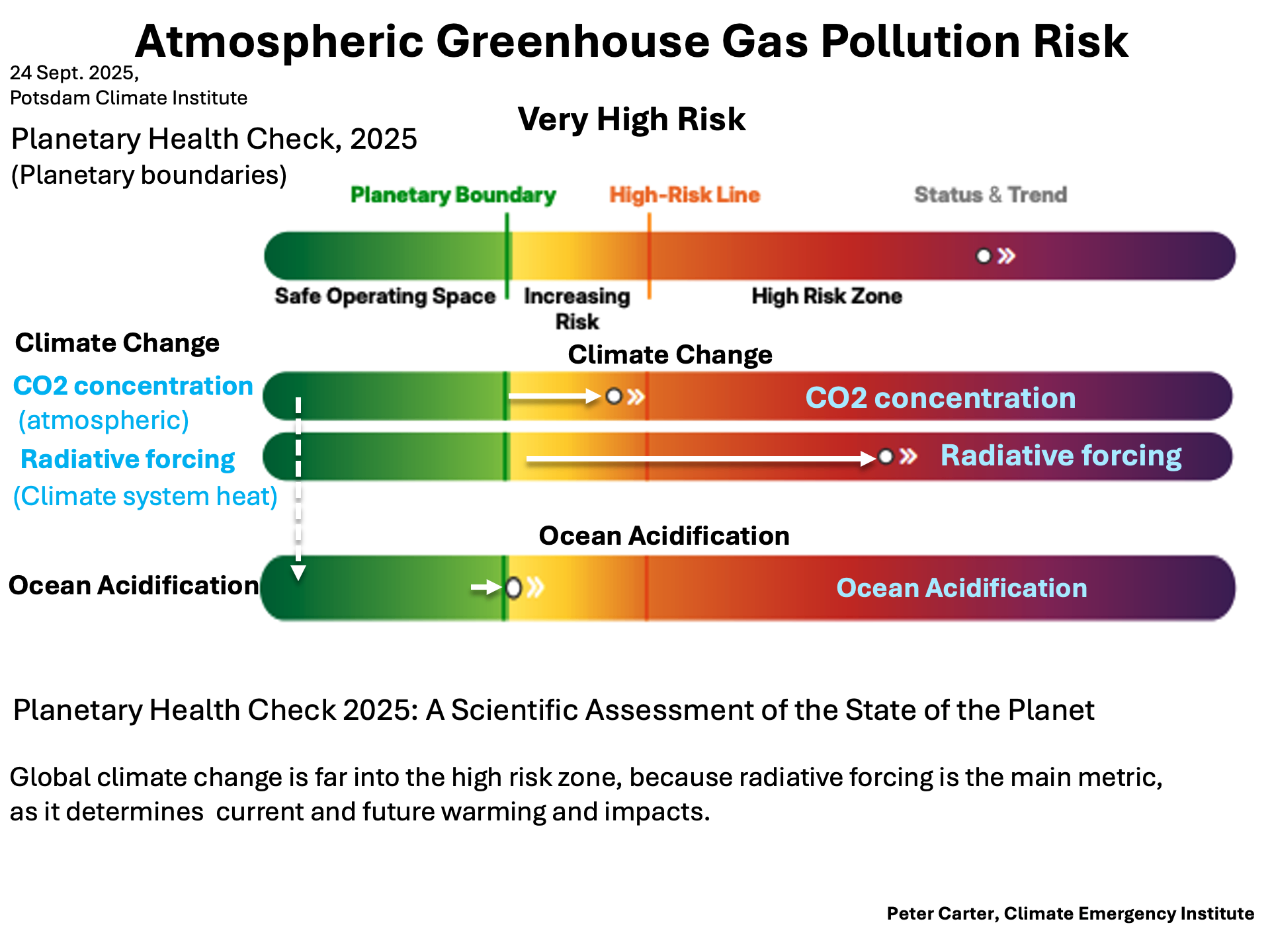
CO2 emissions (mainly fossil fuels) is causing accelerating ocean acidification, as increasing CO2 in the air (atmosphere) dissolves at the ocean surface to form carbonic acid. This has resulted in a 30% increase in ocean acidification.
Today's rate of acidification is unprecedented, roughly 10 times faster than the past 300 million years.
It is exacerbating the ocean warming damage to tropical coral reefs.
It is already adversely affecting come shell forming zoolplankton, essential to the ocean carbon pump.
Ocean acidification will weaken the ocean carbon sink.

Ocean acidification beyond the safe boundary