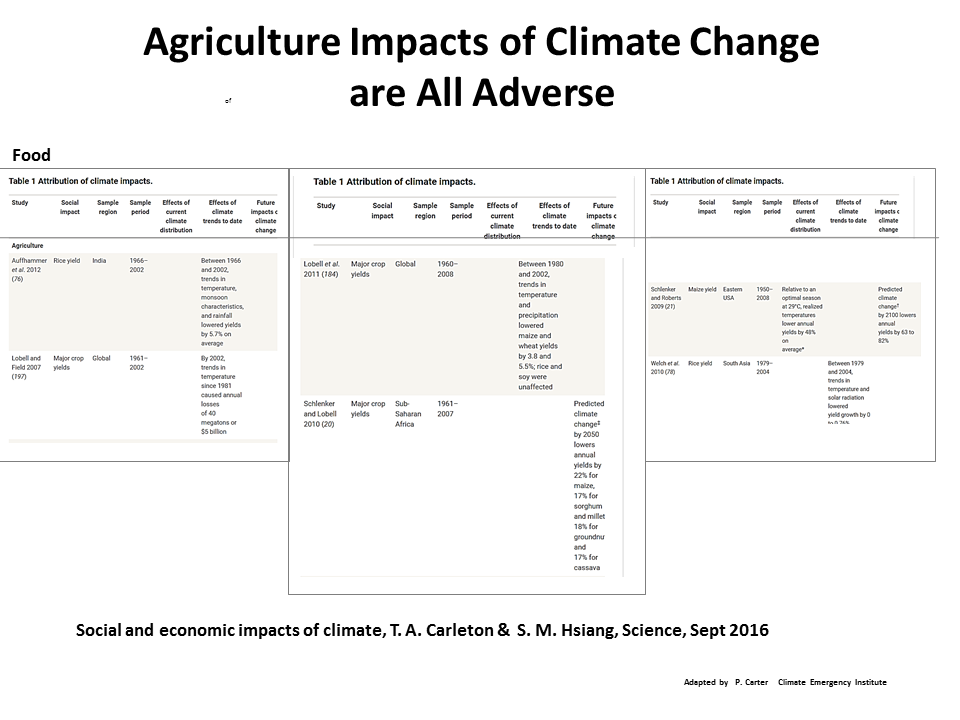
IPCC 5th assessment 2014 Based on many studies covering a wide range of regions and crops, negative impacts of climate change On crop yields have been more common than positive impacts WG2 SPM.
With or without adaptation, negative impacts on average yields become likely from the 2030s with median yield impacts of 0 to –2% per decade projected for the rest of the century, and after 2050 the risk of more severe impacts increases.
September 2014 Scientists on drought: Scientists warn of 'megadroughts'
Nature March 2014 Climate change will reduce crop yields sooner than we thought.
Food Insecurity
CLIMATE EMERGENCY INSTITUTE
The health and human rights approach to climate change
Some important research
2 June 2020 Latest climate models show more intense droughts to come
9 Aug 2018 Physiological and growth responses of potato cultivars to heat stress
31 Aug 2018 Increase in crop losses to insect pests in a warming climate
11 June 2018 Predicted changes could significantly reduce global production of vegetables
23 Jan 2017 FAO-IPCC
LAND USE AND FOOD SECURITY
10 June 2015 Suitable Days for Plant Growth Disappear under Projected Climate Change:
10 Oct 2019 Billions face food, water shortages over next 30 years as nature fails
10 Dec 2019 Jet stream changes -hit global breadbaskets

Food Ch. 5B.1 Human-induced climate change, including more frequent and intense extreme events, has caused widespread adverse
impacts and related losses and damages to nature and people, beyond natural climate variability.
Increasing weather and climate extreme events have exposed millions of people to acute food insecurity and reduced water security, with the largest impacts observed in many locations and/or communities in Africa, Asia, Central and South America, and Small Islands.
Jointly, sudden losses of food production and access to food compounded by decreased diet diversity have increased
malnutrition in many communities, especially for Indigenous Peoples, small-scale food producers and low-income
households, with children, elderly people and pregnant women particularly impacted (high confidence). Roughly half
of the world’s population currently experience severe water scarcity for at least some part of the year due to climatic and non-climatic drivers.
Climate change is contributing to humanitarian crises where climate hazards interact with high vulnerability. Climate
and weather extremes are increasingly driving displacement in all regions, with Small Island States disproportionately affected.
Flood and drought-related acute food insecurity and malnutrition have increased in Africa and Cenral Asia.
Climate change will increasingly put pressure on food production and access, especially in vulnerable regions, undermining food security and nutrition Increases in frequency, intensity and severity of droughts, floods and heatwaves, and continued sea
level rise will increase risks to food security.
Climate change impacts and risks are becoming increasingly complex and more difficult to manage. Multiple climatehazards will occur simultaneously, and multiple climatic and non-climatic risks will interact, resulting in compounding overall risk and risks cascading across sectors and regions.
Some responses to climate change result in new impacts and risks.
Concurrent and repeated climate hazards occur in all regions, increasing impacts and risks to health, ecosystems, infrastructure, livelihoodsand food (high confidence). Multiple risks interact, generating new sources of vulnerability to climate hazards, and compounding overall risk.
Small children are most vulnerable to lack of food and nutrition.
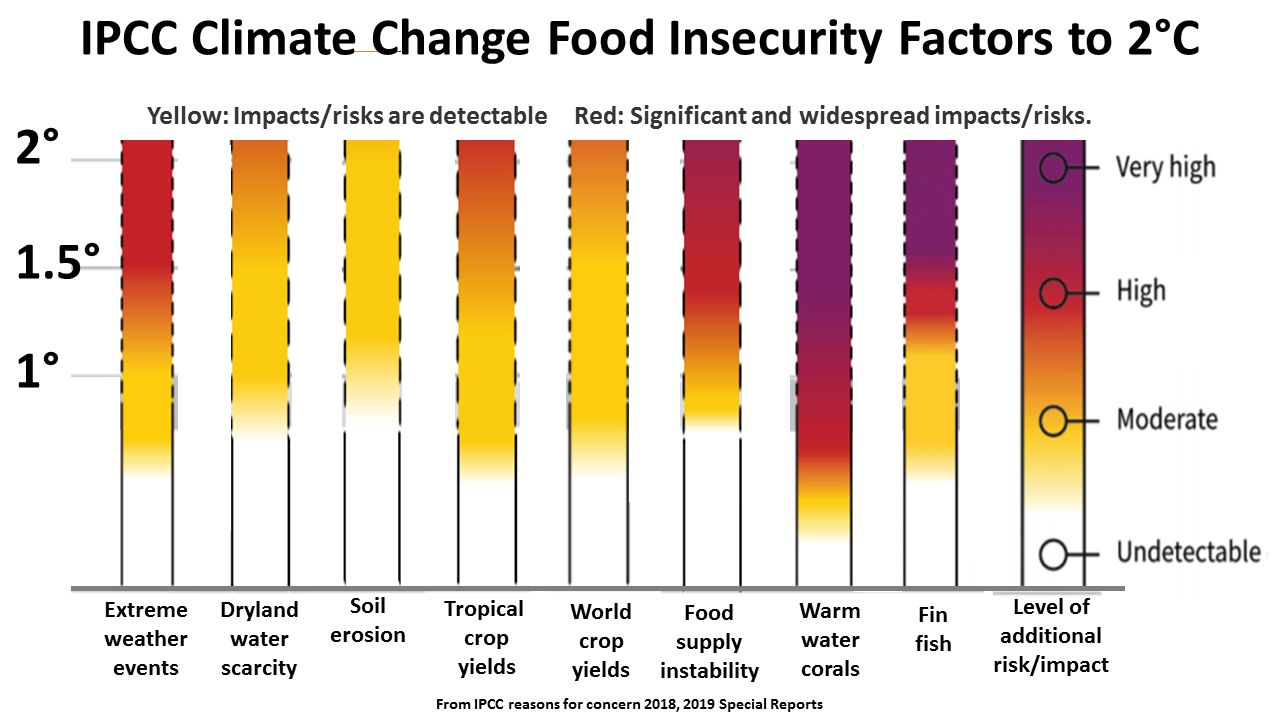

IPCC Reason for Concern
IPCC AR6
Increasing weather and climate extreme events have exposed millions of people
to acute food insecurity12 and reduced water security, with the largest adverse impacts observed in many locationsand/or communities in Africa, Asia, Central and South America, and Small Islands , and globally forIndigenous Peoples, small-scale food producers and low-income households.
Global food systems are currently beyond all nine food system boundaries.
Identifying the safe operating space for food systems, 31 Oct. 2025, S. te Wierik