Species and Ecosystems Emergencies
2 Aug 2013 Science Stanford review reports that ecosystem climate changes will intensify in the coming decades, unfolding at a rate that is potentially several orders of magnitude—more rapid than the changes to which terrestrial ecosystems have been exposed during the past 65 million years. The combination of high climate-change velocity and multidimensional human fragmentation will present terrestrial ecosystems with an environment unprecedented in recent evolutionary history.
IPCC 5th Assessment
During the course of this century the resilience of many ecosystems (their ability to adapt naturally) is likely to be exceeded by an unprecedented combination of change in climate, associated disturbances (e.g., flooding, drought, wildfire, insects, ocean acidification) and in other global change drivers (especially land-use change, pollution and over-exploitation of resources), if greenhouse gas emissions and other changes continue at or above current rates (high confidence).
Many significant impacts of climate change may emerge through shifts in the intensity and the frequency of extreme weather events. Extreme events can cause mass mortality of individuals and contribute significantly to determining which species occur in ecosystems
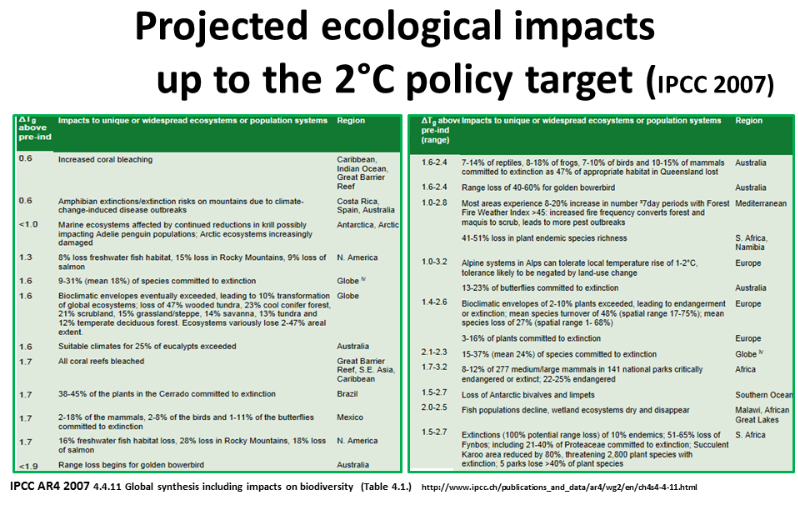
Projected future climate change and other human-induced pressures are virtually certain to be unprecedented compared with the past several hundred millennia
(IPCC AR4 WG2 Ch4 1.2 Key Issues)
Feb 2014 VIDEO The 6th Extinction: Elizabeth Kolbert How Humans Are Causing Largest Die-Off since Dinosaurs
CLIMATE EMERGENCY INSTITUTE
The health and human rights approach to climate change
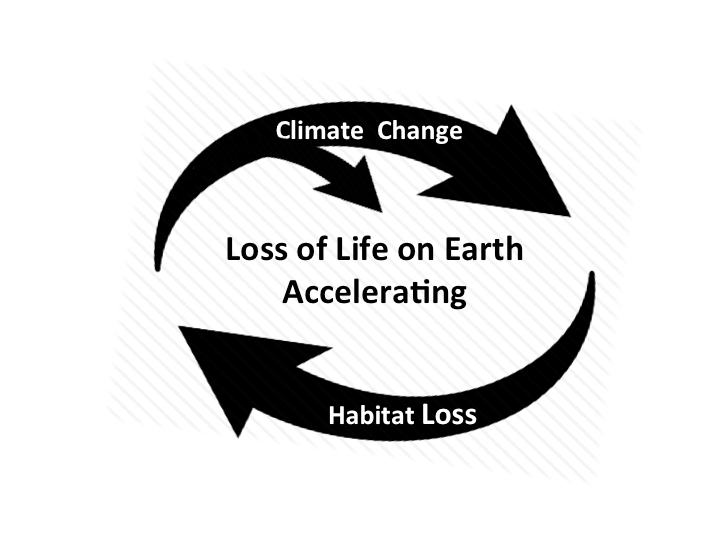
As in general global climate change will harm wildlife directly and exacerbate ongoing harm that has lead to the 6th planetary mass extinction even.
6th mass extinction Global climate change is now impacting on top of the 6th mass extinction
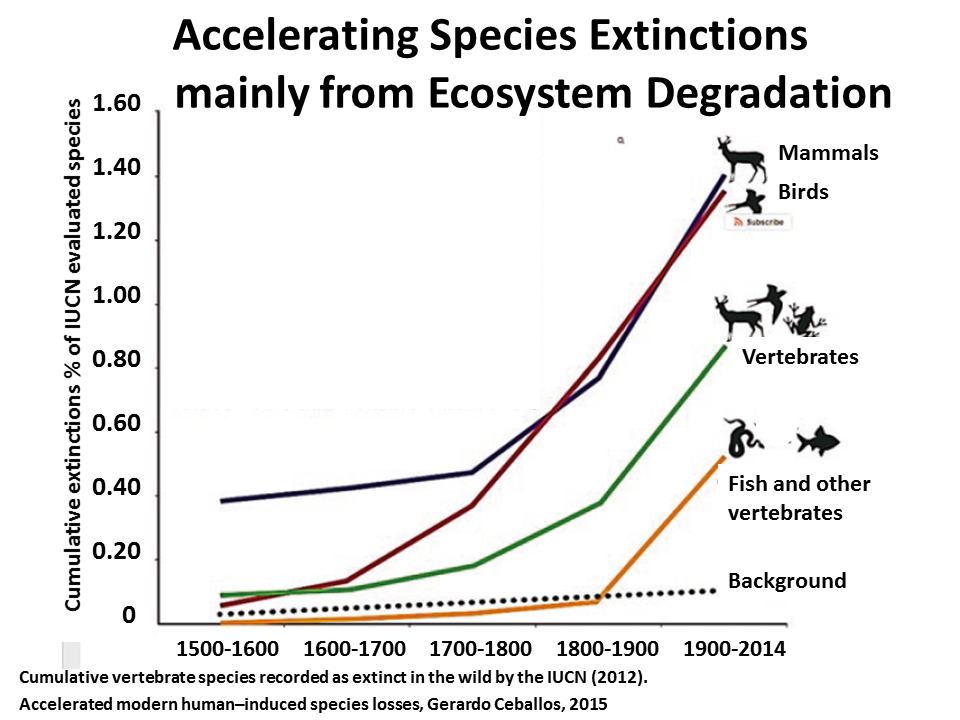
Species being wiped out at 1000 X natural rate Pimm May 2014 mainly caused by habitat destruction and invasive species. Global climate change will lead to habitat damage and destruction, making species seeking new habitats 'alien'.
The 2016 WWF Living Planet Index finds global populations of fish, birds, mammals, amphibians and reptiles declined by 58 per cent between 1970 and 2012.
IPCC 5t Assessment
Climate change at rates slower than current anthropogenic climate change caused significant ecosystem shifts and species extinctions during the past millions of years.
A large fraction of both terrestrial and freshwater species faces increased extinction risk under projected climate change during and beyond the 21st century, especially as climate change interacts with other stressors.
CURRENT RATE OF EXTINCTION IS 100 x NATURAL BACKGROUND RATE:
Extinction risk and rate is increased under all IPCC scenarios, with risk increasing with both magnitude and rate of climate change.
A large fraction of the species assessed is vulnerable to extinction due to climate change, often in interaction with other threats. Species with an intrinsically low dispersal rate, especially when occupying flat landscapes where the projected climate velocity is high, and species in isolated habitats such as mountaintops, islands, or small protected areas are especially at risk.
Cascading effects through organism interactions, especially those vulnerable to phenological changes, amplify risk
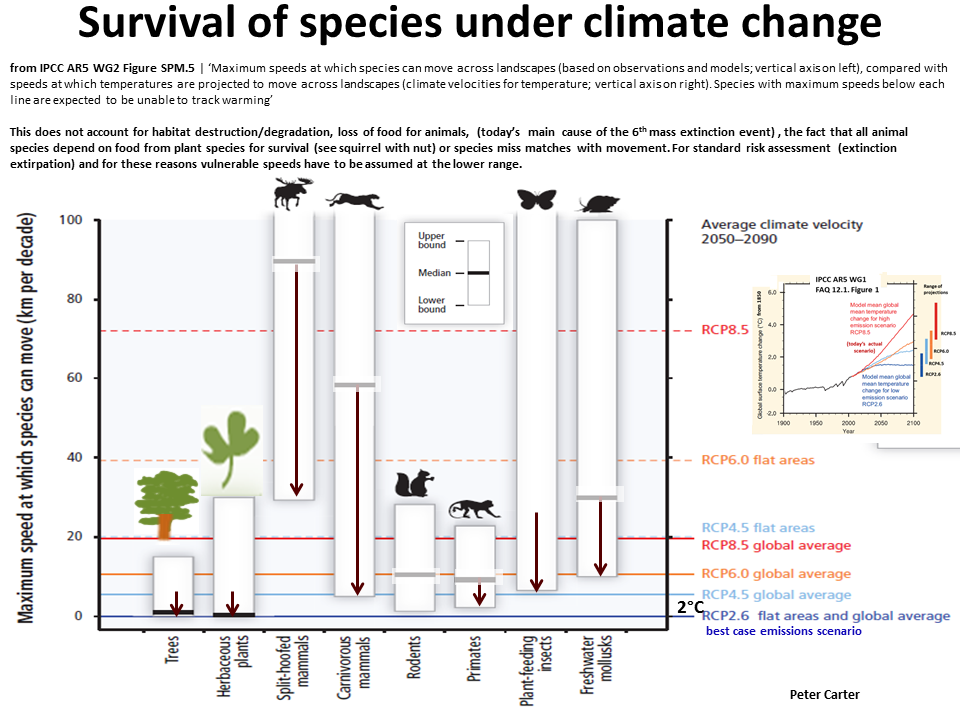
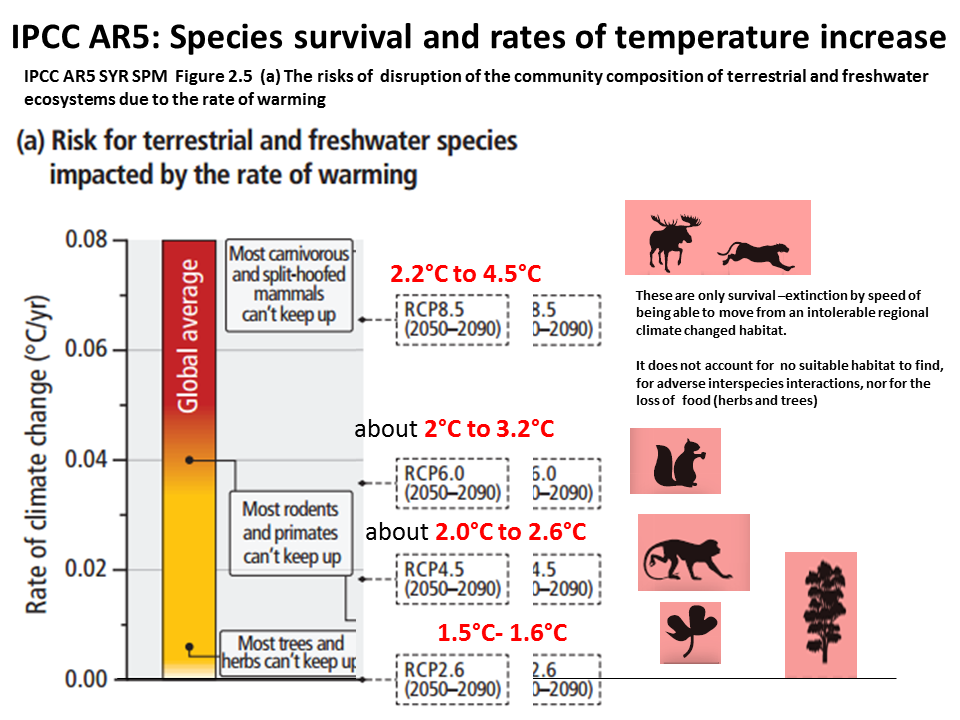
The AR5 uses only the crude speed a species can move to escape increasing degrees of global warming (not the full climate disruption). Obviously, as also recorded in AR5, there many other adverse climate change effects.
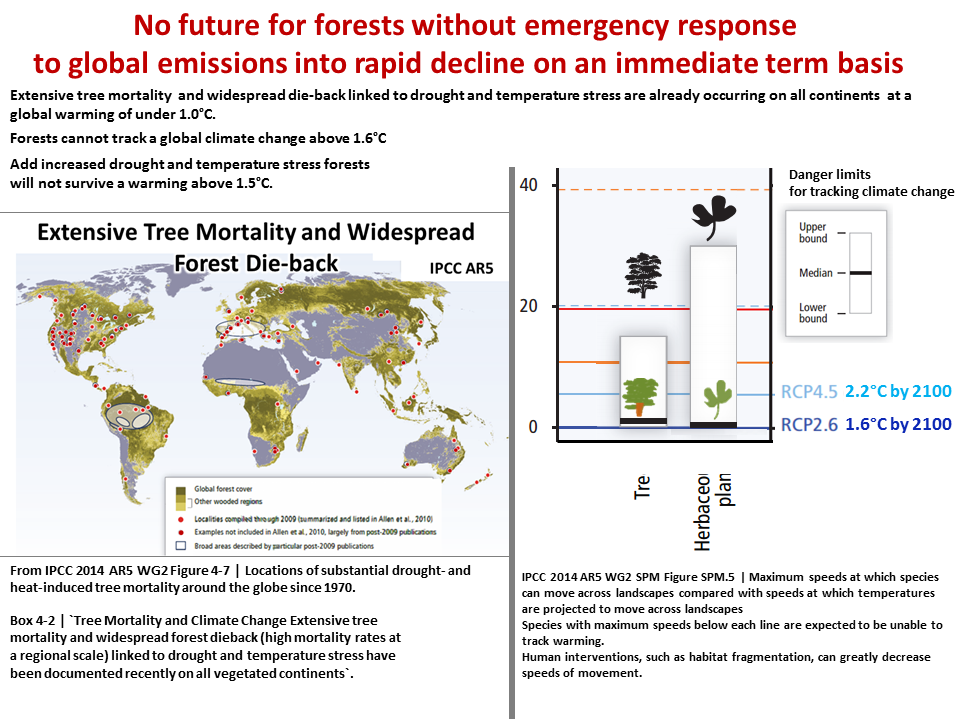
Trees and plants in general lose favorable climate space by 2.0C global warming.
They cannot escape or adapt to the rate of warming affecting their health and supporting ecosystems from a 2.0C global warming (N.B. local land warming is higher than global warming).
Losing favorable climate space is projected to lead to reduced fitness, declining abundance, and local extinction, with potentially large effects on biodiversity and ecosystem services.
On top of losing climate space, climate change causes increasing drying & drought, insect infestation, forest fires and supportive species mismatches, making the situation very much worse. Most trees and plants cannot be expected to survive 2C.
Only the best case emissions scenarios give tree and plant species a chance of surviving climate change. All other scenarios are above 2.0C this century
The impact on tree survival (among other species)will be even more under-estimated due to establishment in a new location.
Estimates of tree displacement rates are frequently based on models or observations of dispersal of seeds controlling establishment of adult trees.
Displacement rates of trees are often more strongly limited by establishment than dispersal.
Many papers published argue that the uncertainty may be even higher than indicated in syntheses of model projections, due to limitations in the ability of current models to evaluate extinction risk. Models frequently do not account for dispersal capacity, population dynamics, the effects of habitat fragmentation and loss and community interactions.
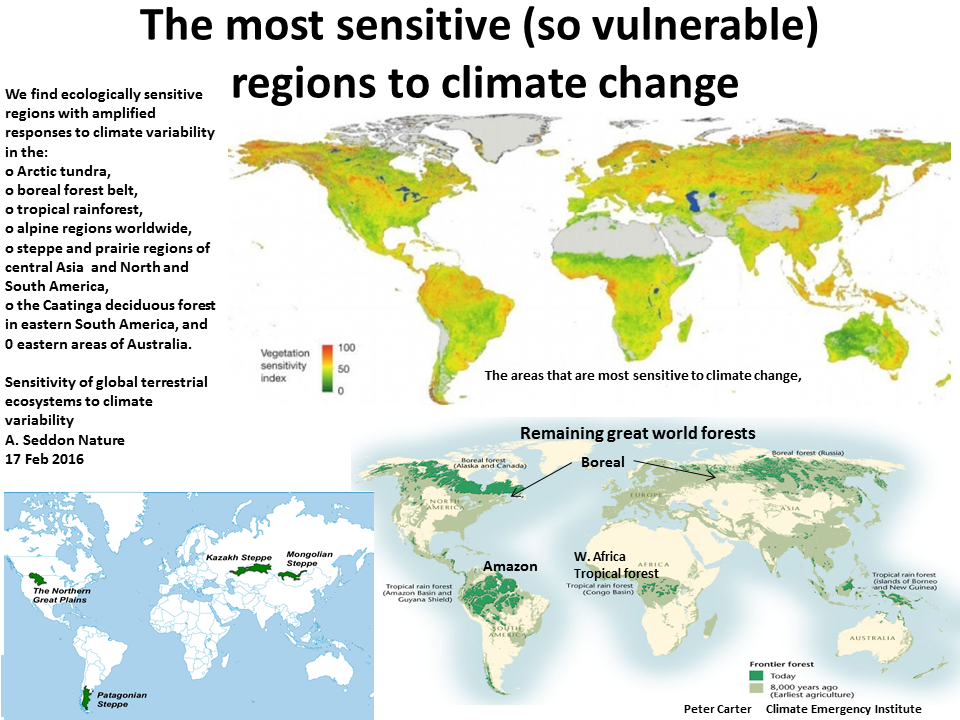
Community interactions not in the models includes what is today the largest cause of species extinctions, which is deforestation and ecosystem alien species. The further large loss of forests will drive populations and species extinctions faster than estimated by climate space models, and even species that can move fast will be alien species.
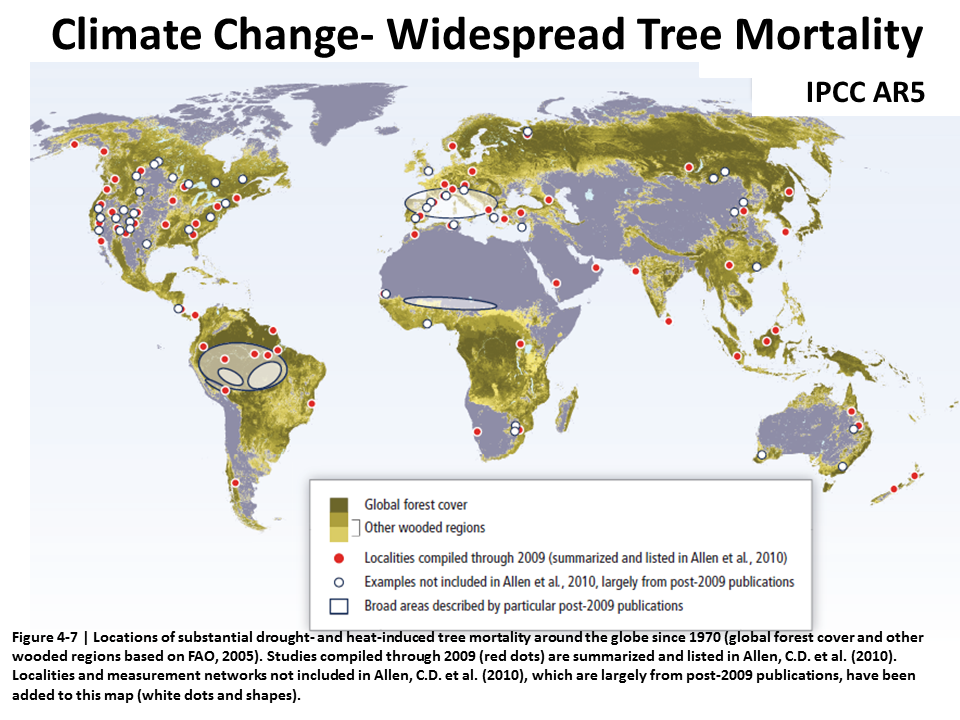
Extensive tree mortality and widespread forest die-back (high mortality rates at a regional scale) linked to drought and temperature stress have been documented recently on all vegetated continents.
long-term increasing tree mortality rates associated with temperature increases and drought have been documented in boreal and temperate forests in western North America. Episodes of widespread die-back (high mortality rates at a regional scale) have been observed in multiple vegetation types, particularly in western North America, Australia, and southern Europe. (AR5 WG2 Box 4-2 Tree Mortality and Climate Change).
In addition forest fires are increasing and will be widespread by 1.8C global warming.
May 2017 'Biological Annihilation' Rapidly increasing rate of species extinctions EARTH EMEGENCY
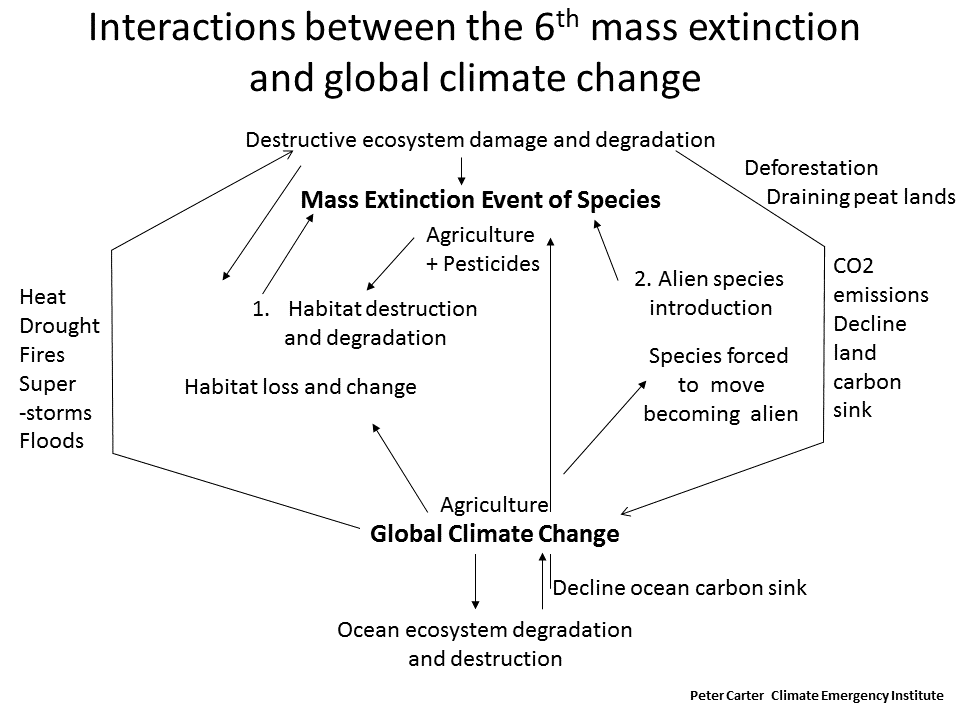
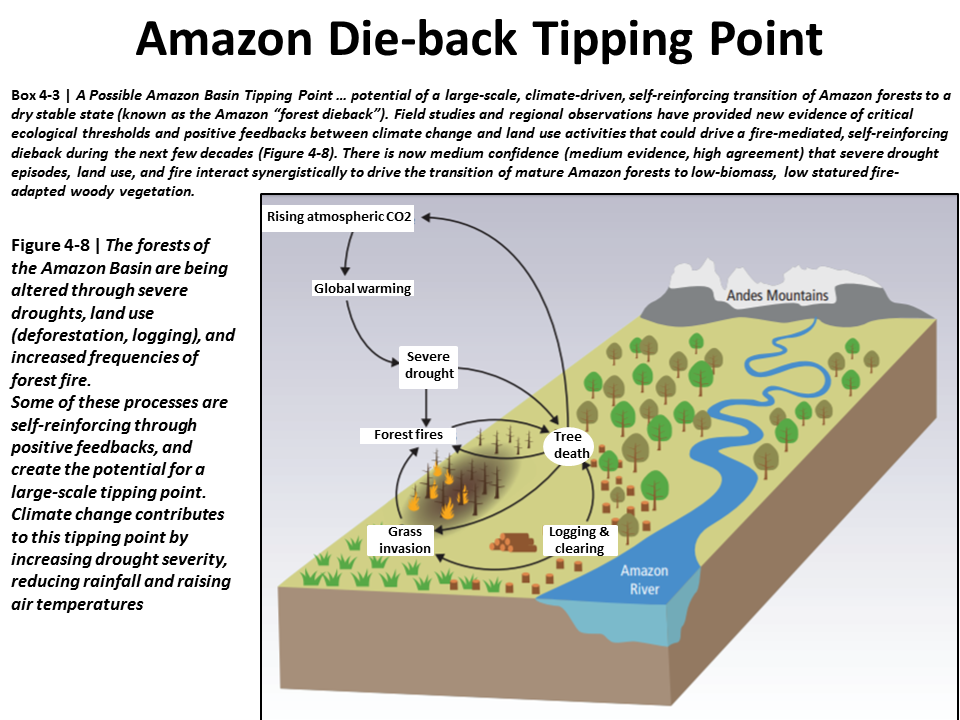
Double Feedback Global climate change will boost today's
already 6th Earth mass extinction event and cause
damage to ecosystems which will increase global climate change
by reduction of CO2 uptake.
6th Mass Extinction
IPCC AR5 Amazon die back. Large CO2 source- switched from large sink
13 Nov 2018 'Co-extinctions annihilate planetary life during extreme environmental change'
Eradicating Ecocide site
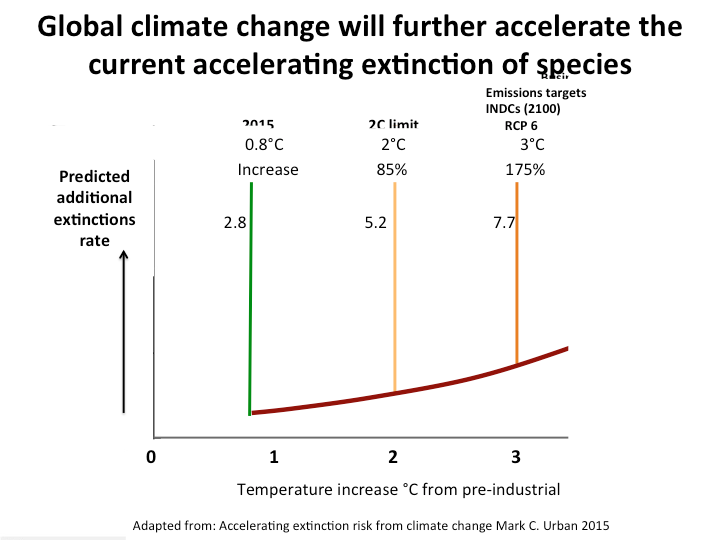
May 2015 Global climate change further accelerates extinctions.
Accelerating extinction risk from climate change, Mark C. Urban
IPBES May 2019 UN assessment Nature’s Dangerous decline Unprecedented Extinction Rates -Accelerating Nature's Emergency
15 May 2019 Deadly Cascade
13 Dec 2019 Pervasive human-driven decline of life on Earth needs immediate transformative change.
Sept 2020 WWF Unprecedented wildlife decline -68% since 1970
1996 Richard Leakey The Sixth Extinction: Patterns of Life & the Future of Humankind

UN Report, : Nature’s Dangerous Decline ‘Unprecedented’; Species Extinction Rates ‘Accelerating’
IPBES, 6 May 2019
Human activities have resulted in "unprecedented effects on biodiversity"
"Our findings show that all five factors have a strong impact on biodiversity worldwide, in all groups of organisms and in all ecosystems."26 March 2025, The global human
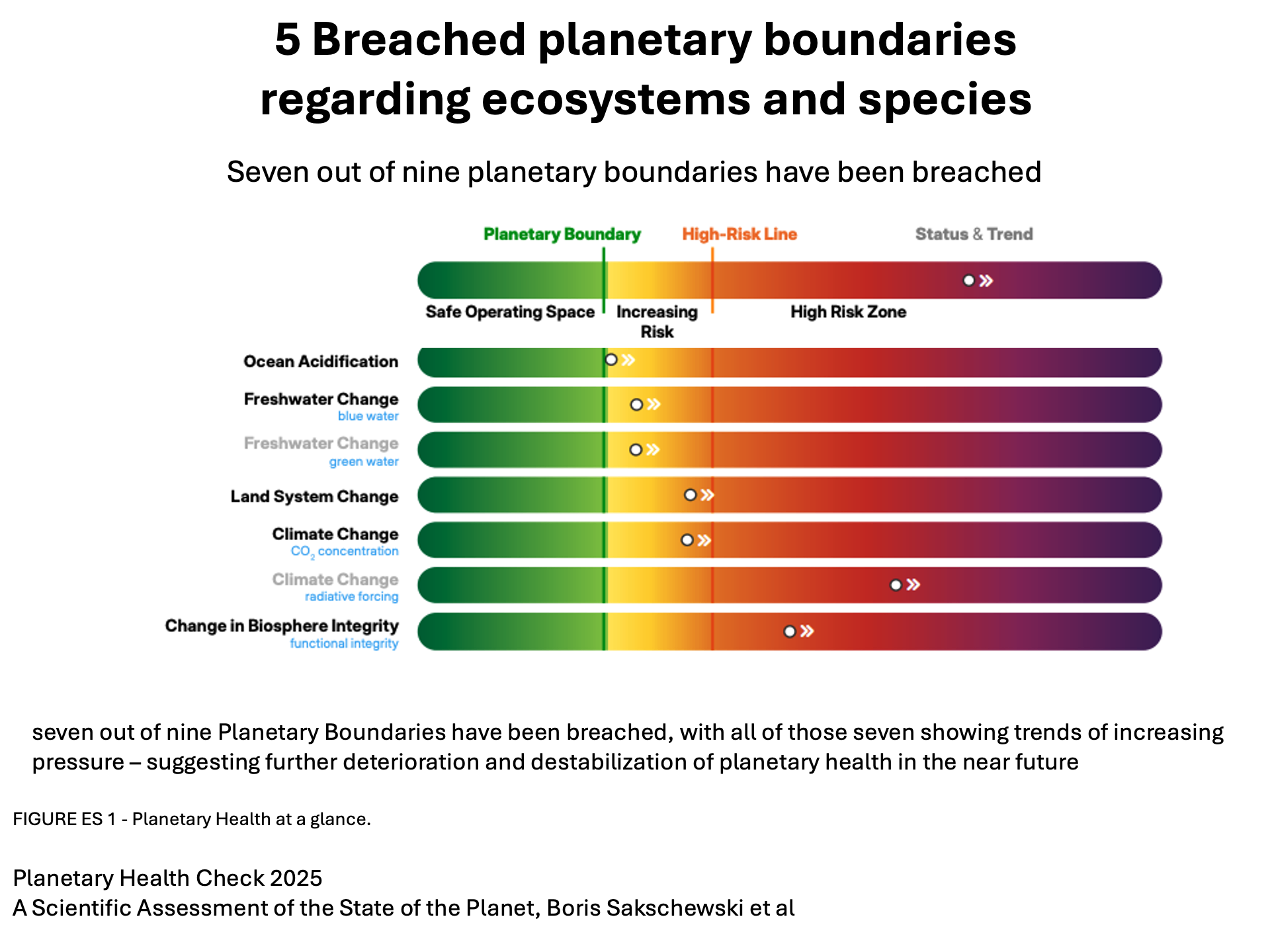
Ocean acidification is beyond the safe planetary boundary. It threatens entire ecosystems. It has increased 30%, is accelerating, and its rate of increase is far faster than the past 300 million years.
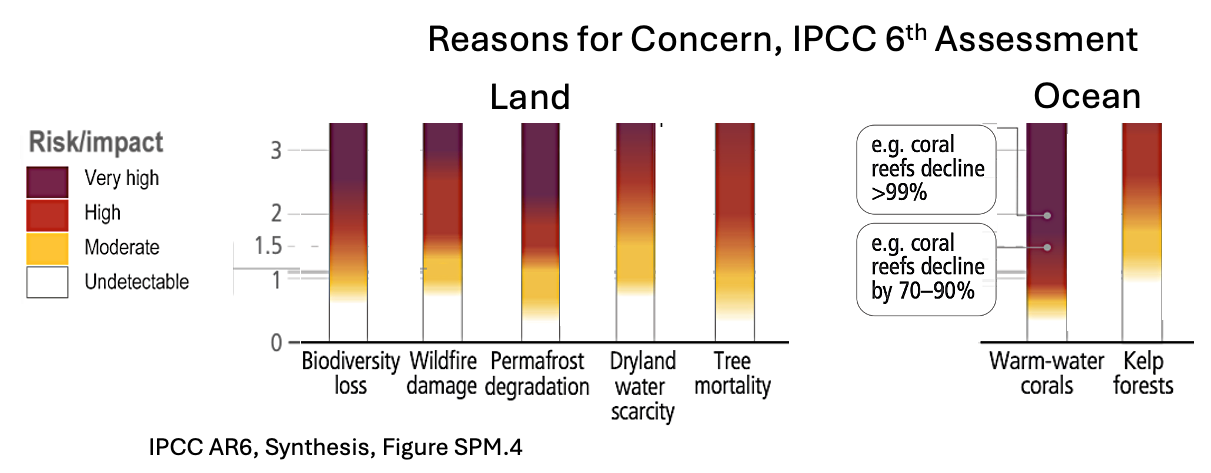
IPCC AR6, Synthesis
Human and ecosystem vulnerability are interdependent.Impacts on some ecosystems are approaching irreversibility.Some tropical, coastal, polar and mountain ecosystems have reached hard adaptation limits.In the near term, every region in the world is projected to face further increases in climate hazards , increasing multiple risks to ecosystems and humans.Loss of ecosystems and their services has cascading and long-term impacts on people globally, especially for Indigenous Peoples and local communities who are directly dependent on ecosystems to meet basic needs. The likelihood and impacts of abrupt and/or irreversible changes in the climate system, including changes triggered when tipping points are reached, increase with warming.
As warming levels increase, so do the risks of species extinction or irreversible loss of biodiversity in ecosystems including forests, coral reefs and in Arctic regions.Above 1.5°C of global warming, limited freshwater resources pose potential hard adaptation limits for small islands and for regions dependent on glacier and snow melt (medium confidence). Above that level, ecosystems such as some warm-water coral reefs, coastalwetlands, rainforests, and polar and mountain ecosystems will have reached or surpassed hard adaptation limits.
IPCC 6th Assessment